Commercial art of Toulouse Lautrec, Alphonse Mucha and Jules Cheret
The concept
To begin with, it is significant to point out the reason for taking this particular topic for the research. First of all, it was done due to the author’s deep passion for Art Nouveau and a desire to explore it thoroughly. Secondly, commissioned art and commercial illustration were as popular during the beginning of the 20th century as they had ever been. However, each artist had their own unique approach and vision. Thus, it would be thrilling to highlight those differences and do my best to explain them profoundly. Finally, commercial illustration is in its prime now, hence there is an actual necessity to trace back the illustration trends and methods that were implemented 100 years ago and currently have developed into something absolutely different, though having the same roots and patterns.
The guidelines for collecting the material—artworks—are simple. The images were picked and sorted according to their purpose and origins. In other words, I was not looking for any pictures that had been produced as a creative flow of the artist and had not had any restrictions. Rather, my goal was to find the artworks that had been commissioned. Hence, the masterpieces must have met several criteria, on which I am going to elaborate just below. Firstly, the image had its commissioner, meaning it was paid for and expected to be delivered due to the specific deadline. Secondly, the primary goal of the artwork was to draw a potential customer’s attention, most likely to sell a product or advertise a service. Additionally, the design must have had some expectations and customer-laid regulations, since it was a commercially oriented product rather than an instance of art in its concept.
Additionally, the structure of this visual research is not sophisticated. Therefore, the main body starts with examining the patterns the artists used in their posters. By using the word «patterns,» it is implied both the art methods such as lines, curves, dots, etc., and samples that can be seen through the entire work series. In like manner, it is being elaborated on the market fields that placed orders for the artists. This part of the research might be fairly claimed as the most marketing-oriented, since it is completely devoted to the customers and ways how the business operates. Further, the author delves into the plot of the pictures, which can be pretty straightforward as well as complicated and contain several layers of the narrative at the same time.
Moreover, the next part is dedicated to the composition and accents and reveals the similarities and differences in this matter of all the mentioned artists. Similarly, the following paragraph examines the typography and layout, because as a product of advertisement it should have contained texts and graphical prompts in order to encourage the consumers to indulge in the promoted products and services.
Not to be overlooked are the guidelines for using the text materials such as books and articles. To put it simply, this research is mainly based on the sources that explore artists of Art Nouveau. Besides, there are some basic art history books and non-fiction compilations in order to provide the most accurate cultural context.
Furthermore, the key question for this article can be formulated as follows: «What were the main market demands for commercial illustration in the period of 1890-1910 and how did the various artists respond to those demands with their unique approaches?» The hypothesis is that there were several trends and market expectations that allowed culturologists to outline the Art Nouveau style, however the masters performed with absolutely different techniques.
The patterns
There are several types of patterns that can be tracked down in the artworks. It is worthwhile to mention that most of the patterns have their roots in the «Arts and Crafts» style. In other words, those elements are flower-like and wholly inspired by nature.
However, it is Alphonse Mucha who used vivid patterns in most of his posters. In his artworks, the characters and objects are fused with the complicated ornament and cannot be separated from each other by any means.
Box for Lefèvre-Utile biscuits Gaufrettes Vanille, 1900, Alphonse Mucha
On the contrary, Jules Chéret and Toulouse-Lautrec used scattered dots, curly lines, and some broad strokes. Once again, to highlight the difference between Alphonse Mucha’s and theirs, it should be mentioned that those strokes and simple patterns served mostly as a background rather than being a part of the composition.
Not to be overlooked is the fact that in many of Toulouse-Lautrec’s paintings, there are no patterns at all, which makes him closer to the next era of the commercial poster.
Packaging for Lefèvre-Utile biscuits Boudoir, 1901, Alphonse Mucha
Packaging for 'Savon Mucha Violette', 1906, Alphonse Mucha
Poster for 'Bières de la Meuse', 1897, Alphonse Mucha
Poster for 'Job' cigarette paper, 1896, Alphonse Mucha
Poster for 'Job' cigarette paper, 1898, Alphonse Mucha
Poster for 'La Dame aux Camélias', 1896, Alphonse Mucha
Poster for 'La Samaritaine', 1897, Alphonse Mucha
Poster for 'La Tosca', 1899, Alphonse Mucha
Bagnères de Luchon, Fêtes des Fleurs, 1890, Jules Cheret
Confetti, 1894, Toulouse Lautrec
Casino d’Enghien, 1896, Jules Cheret
Folies Bergères, Emilienne d’Alençon, 1899, Jules Cheret
Recoloration des Cheveux par l’Eau des Sirènes, 1900, Jules Cheret
Saxoléine, Pétrole de sureté, 1900, Jules Cheret
Théâtre de l’Opéra, Carnaval 1894, Jules Cheret
Théâtre de l’Opéra, Carnaval 1896, Grand Veglione de Gala, 1896, Jules Cheret
Divan Japonais, 1893, Toulouse Lautrec
Commissioners
Box for Lefèvre-Utile biscuits Madère 1900, Alphonse Mucha
While in the past the majority of an artist’s clientele were either the Church or wealthy noblemen, by the end of the 19th century, times had changed and most commissions were placed by various companies.
The key word is «various.» It was not a single field that had a high demand for paper advertisements, rather it was the whole market that required such promotion. Thus, Alphonse Mucha, Jules Chéret, and Toulouse-Lautrec were commissioned to create designs both for cabaret performances and infant feeding products made by Nestlé.
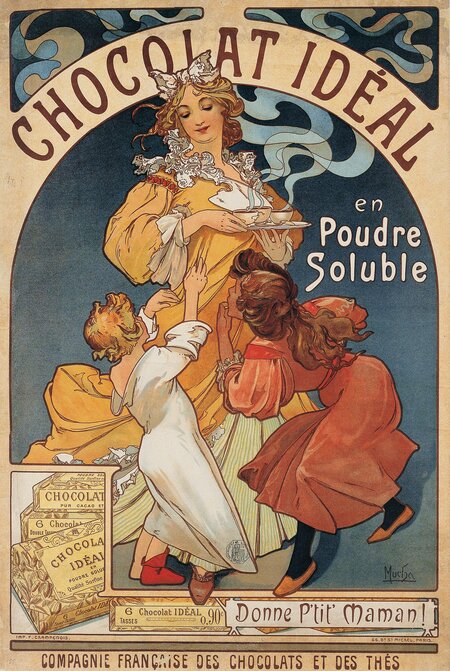
Poster for 'Chocolat Idéal', 1897, Alphonse Mucha
Packaging for 'Savon Mucha Violette', 1906, Alphonse Mucha
Champagne Ruinart 1896
Bénédictine 1898, Alphonse Mucha
Lance Parfum Rodo, 1896, Alphonse Mucha
Saxoléine, Pétrole de sureté, 1895, Toulouse-Lautrec
Miss Églantine’s Dance Troupe, 1896, Toulouse Lautrec
The plot
Eldorado Aristide Bruant, 1892, Toulouse Lautrec
The Art Nouveau style is famous for its theater-like atmosphere. Hence, many of the posters imply a story behind them. Quite often, the main character is a young dancing woman dressed in colorful attire, moving and smiling warmly. Sometimes, the artists depict gentlemen who face daily life or, on the contrary, play the role of fictional characters. In any case, the bright color palette and peculiar shapes of clothes create a fairytale mood.
The role-playing concept is a pretty important one for Art Nouveau because the posters display celebrations and people wearing masks and costumes, commonly with purposefully distorted proportions, which makes the art more outstanding and desirable than ever before.
Aristide Bruant dans son cabare, 1892, Toulouse Lautrec
Cover for Old Stories, 1893, Toulouse Lautrec
Poster for 'Cycles Perfecta', 1902, Alphonse Mucha
Humber Cycles, 1896, Toulouse-Lautrec
The Simpson Chain (La Chaîne Simpson), 1896, Toulouse-Lautrec
The Hairdresser, 1893, Toulouse-Lautrec
Frontispiece from Elles, 1896, Toulouse-Lautrec
Sick Carnot! , 1893, Toulouse-Lautrec
Moulin Rouge La Goulue, 1891, Toulouse Lautrec
The Photographer Sescau (Le Photographe Sescau), 1896, Toulouse-Lautrec
The Queen of Joy (Reine de joie), 1892, Toulouse-Lautrec
Box seat with a Gilded Mask (La Loge au mascaron doré), 1893, Toulouse Lautrec
Jardin de Paris, Fête de Nuit Bal, 1896, Jules Cheret
May Belfort, 1895, Toulouse-Lautrec
Concert des Ambassadeurs, Champs-Élysées, 1890, Jules Cheret
Composition and accents
Pippermint, Get Frères, 1900, Jules Cheret
The prominent feature in Art Nouveau composition is dynamics. Many posters utilize diagonals as their compositional basis. There are very few straight lines and static shapes overall.
As mentioned in the previous paragraph, the main character is a young woman, and she is almost never standing still. Artists depict figures dancing, pouring wine, kissing, and combing hair. In general, shapes in the images are curved and comically proportioned. People are drawn with their limbs apart and bodies leaned to one side. The main center of attention is the upper part of the poster, unless it is a magazine cover and is cramped with headlines.
Taverne Olympia, Restaurant, 1896, Toulouse-Lautrec
Jane Avril, 1899, Toulouse-Lautrec
Hippodrome de la Porte Maillot, Paris Courses, 1900, Jules Cheret
German Babylon (Babylone d’Allemagne), 1894, Toulouse Lautrec
Poster for 'Hommage Respectueux de Nestlé', 1897, Alphonse Mucha
L´Aureole du Midi, Pétrole de sureté, 1900, Jules Cheret
Quinquina Dubonnet, 1895, Jules Cheret
May Milton, 1895, Toulouse Lautrec
Next at the theater Aristide Bruant, 1893, Toulouse Lautrec
The dawn, 1896, Toulouse-Lautrec
Moulin Rouge, Paris, Cancan, 1890, Toulouse Lautrec
Typography and layout
Pan, a Journal of Satire, 1900, Toulouse Lautrec
Since each of the examined artists had their own view on typography and their works are completely unique in this way, this part of the research is one of the most fascinating. To draw an example, let us have a look at several posters by Alphonse Mucha provided below. He did not care much if the text covered the drawing or was covered by it. Rather, it was his original design as he might have considered every element of the poster as a whole. According to modern rules of graphic design, this would be unacceptable because this overlay severely decreases readability. Nevertheless, from Mucha’s point of view, it was the only right thing, because it provided harmony and unification.
On the other hand, Jules Chéret and Toulouse-Lautrec were more considerate of this matter. For instance, Jules Chéret mostly always provided enough free space for this issue and used contrasting colors alongside outlines to make the text as vivid as possible.
Poster for 'La Tosca', 1899, Jules Cheret
Poster for 'Imprimerie Cassan Fils', 1896, Alphonse Mucha
Flirt, 1899, Alphonse Mucha
Vin Mariani, 1894, Toulouse-Lautrec
A Gentleman and a lady, 1895, Toulouse Lautrec
Amants, 1895, Alphonse Mucha
The White Review (La Revue blanche), 1895, Toulouse-Lautrec
Irish and American Bar The Chap Book, 1895, Toulouse-Lautrec
Poster for 'Biscuits Champagne Lefèvre-Utile', 1896, Alphonse Mucha
At the Moulin de la Galette, 1896, Toulouse Lautrec
Conclusion
To take into consideration all of the above, it is necessary to mention that there is a clear reason for these artists to be united under a single style. However, Alphonse Mucha, Jules Chéret, and Toulouse-Lautrec were inspired by various situations, and their designs were different too. Undoubtedly, they founded a great base for future commercial illustrators.
Mucha Foundation.
Jules Chéret and the History of the Artistic Poster Driehaus Museum.
The Art Nouveau Style Guide, 1999, by William Hardy.
Art Nouveau: 50 Works Of Art You Should Know, Susie Hodge, Prestel Publishing, 2015
Exploring the Invisible, Lynn Gamwell.
Alphonse Mucha: The Spirit of Art Nouveau, Victor Arwas.
Alphonse Mucha, Ronald F. Lipp.
Art Nouveau, Gabriele Fahr-Becker.
Art Nouveau, Paul Greenhalgh.
Alphonse Mucha (Czechoslovakian, 1860-1939). Job Cigarette Papers | Lot #61369 | Heritage Auctions
Alphonse Mucha | LANCE PARFUM RODO. 1896. | MutualArt
bing.com/newtabredir? url=http%3A%2F%2Fauctions.posterconnection.com%2Flefevre_utile___gaufrettes_vanille_by_alphonse__mu-lot2149.aspx
Jules Chéret | Artnet
Jules Cheret — 34 artworks — painting
Jules CHERET, Louis-Maurice BOUTET de MONVEL, Alfred CHOUBRAC — Cycles Humbert, La Petite Poucette & Théâtre de la Tour Eiffel, 1886 — Set of 3 small lithographs poster — Post War & Modern Art — Plazzart
1353697380-0517175-www.nevsepic.com.ua.jpg (2227×3050)
1353759978-0468455-www.nevsepic.com.ua.jpg (2565×3885)