Concept
Even since the late Roman Empire, Byzantine painters during the iconoclasm period lauded emperors, placing them in the same milieu as saints. Works that glorified rulers maintained narrative unity with icons: the glorification, the creation of an exceptional idealized image, the realistic rendering of details, and lavish solemnity.
The hypothesis of the current visual study is the continuity of Byzantine ideas, embodied in the paintings of Soviet artists from the Stalinist period.
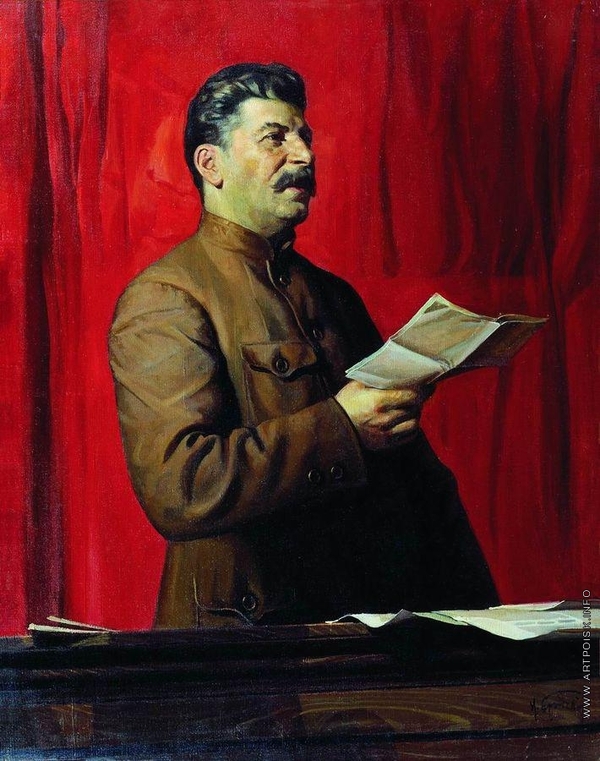
The iconography of a leader within the context of Joseph Vissarionovich’s personality cult would be reflected in a series of propaganda works. Images of I.V. Stalin can be viewed as an iconographic standard, naturally with its own specific characteristics.
The study systematically examines the striking events and eras in the party leader’s life that resonated most strongly with the public:
- Stalin reads Lenin’s letter;
- Spillage;
- Stalinist government congresses;
- Farewell to the dead;
- Leader-Commander;
- Post-war triumph.
The subjects are arranged in an order that provides a schema of the natural transformation of Stalin’s image, in which a clear direction is expressed. Primarily, they reflect the main aspects of his political and social role.
The subject of the current research is interesting because of its ambiguity: the Soviet Union is known as an atheistic state. The rejection of religion was promoted by party and state organs until 1988. Nevertheless, it is difficult to deny the unique approach to portraying the figure of Joseph Vissarionovich and other prominent party figures. This included the repetition of Christian themes, iconographic elements in the composition, and a sublime mood reminiscent of a deeply personal revelation. These described iconographic motifs can manifest in various aspects of the paintings: the locations; the appearance of Joseph Vissarionovich; or the other figures in the paintings, who enter into hierarchical relationships with the leader. All the above elements could constitute a distinct visual system of Stalin.
The rejection of spirituality, coupled with the solemn status of the state ruler, forms the basis of the image’s duality. Joseph Vissarionovich, as a phantom figure, generates more than one contradiction. Similarly, the monumentality of the leader’s image and his presumed earthiness conflict with other characteristics on an ideological level.
If even the theoretically named concepts form a logical inconsistency, how would that be expressed in the paintings?
1. Stalin reads Lenin’s letter
P. Vasiliev. «I.V. Stalin Reads a Letter from V.I. Lenin, Received by Him While in Exile in Siberia»
The first well-known instance of interaction between two «leaders» of the USSR became quite public among the creators of that era. A week after Vladimir Ilyich’s death, a sensational story from Stalin emerged:
Lenin’s letter was relatively brief, but it offered a bold, fearless critique of our party’s practices, along with an excellently clear and concise summary of the party’s entire plan for the near future.
Only Lenin could write about the most complex matters with such simplicity, clarity, conciseness, and courage—when every phrase doesn’t just speak, but fires a shot. This simple and courageous letter further strengthened my belief that we have a mountain eagle in Lenin for our party.
I cannot forgive myself for having turned over Lenin’s letter—and many other letters—to be burned, out of habit from my old underground days.
N. Zhukov. «I.V. Stalin Reads a Letter from V.I. Lenin in Exile. 1903.»
In the paintings, this theme assumes a certain intimacy, a secret quality, almost a biblical revelation. The scenario of burning was never realized in order to preserve the value of the moment.
Light seems to emanate from the letter (although it is obvious that it emits nothing), striking Yosif Vissarionovich. Stalin is in a modest, private setting of exile, which lends the hero of the paintings an innocent simplicity, brings him closer to the people, and makes him a universal hero bearing grace within the «holy» letter.
N. Terpsikhorov. «Lenin’s First Letter to Stalin. New Uda»
2. Spill
The theme of ideological kinship between the two leaders continued in the setting of Razliv. Although the events depicted on the canvases never actually occurred, this subject provided the most straightforward way to illustrate Iosif Vissarionovich’s loyalty to Lenin’s ideas. The scene of the meeting was realized in the artists' works, further strengthening the image of Stalin as Vladimir Ilyich’s successor among viewers.
N. Zhukov. «V.I. Lenin and I.V. Stalin in Razliv.» 1949.
P. Rozin. «V.I. Lenin and I.V. Stalin in Razliv.» 1950.
The figures are depicted engaged in friendly interaction, as if transferring status, role, or the image of adoration and reverence. Comparable to the Holy Father and the Holy Son, they are unified. The leaders appear relaxed yet are imbued with mutual respect.
P. Mityushev. «I. V. Stalin with V. I. Lenin in Razliv» 1949.
I. Vladimirov. «Lenin and Stalin in the Summer of 1917»
They share daily routines, which binds the characters together even more deeply—not on a personal level, but on a fundamental, human one.
On Lenin’s and Stalin’s canvases, they converse, but we do not see direct visual confirmation of it—their mouths are closed. Their gestures and gazes merely confirm the dialogue hidden from the viewer.
3. Stalinist Government Conferences
(Left) F. Reshetnikov. «The Great Oath.» 1949. (Right) F. Modorov. «Stalin’s Report at the Extraordinary VIII Congress of Soviets on the Draft Constitution of the USSR, November 25, 1936.» 1937.
A. Gerasimov. «I.V. Stalin’s Speech at the 16th Party Congress.» 1935.
Images of Stalin at congresses are interesting for how they portray the leader’s oratorical skills, as well as his perception by the public. The majesty of the typical meeting halls, adorned with Soviet paraphernalia, only underscores the power of Iosif Vissarionovich and the tension he maintains in the air.
A. Gerasimov. «Stalin and Delegates of the Second All-Union Congress of Kolkhoz Workers-Stakhanovites, 1935»
V. Svarog. «Stalin’s Report on the Adoption of the 1936 Constitution.» 1938.
Often, the smooth raising of his arm is visualized—it can be relaxed and inspiring, or energetic and commanding—but it always captures the audience’s attention. Stalin is monumental, stoic. The people, in turn, listen to him selflessly, as if he were a prophet. This demonstrates the canonical embodiment of the ideology: «person—crowd—leader.»