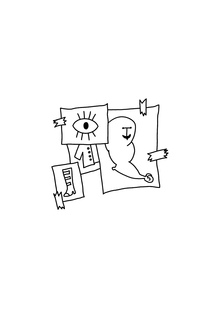
— Flix, what is this? — Makar examines the strange object made of cardboard, paperclips, and some tubes with intense concentration. — It’s a prototype! — Flix proudly replies. — A unique gaming chair. With a cookie tray and wings for style.

Makar smirks: — And I drew sketches for a cool backpack. It has a charger, a sandwich compartment, and a built-in umbrella. — Perfect! We are creating industrial design right now. It’s not just about being beautiful. It’s about being convenient, unique, cool—and actually functional.

What to Expect in the Industrial Design Course
You will learn to sketch and conceive form. You will practice quickly and clearly illustrating ideas—so that it is immediately visible: here is the pen, here is the knob, and here is the slot for the cookie.
You will study materials and their properties. You will learn how plastic, cardboard, fabric, and even foil behave. And why you cannot make a mug out of wood without sealing it.
Inventing and improving objects. You will learn to look at the most ordinary things and devise ways to make them more user-friendly: a bottle, a pencil case, a mop, a chair.
Working with volume and modeling. You will assemble real prototypes from paper, cardboard, or 3D pens. You will understand how an idea transforms into a tangible object.
Learning to present your ideas. You will learn to articulate why your heated chair with a phone holder and integrated lighting is not fantasy, but a genuine design solution.
Warm-up Exercise: Choose an Object → Improve It → Draw It
Look around you and find an object that seems inconvenient. For example, a mug where the spoon won’t fit, or a chair you keep sliding off of.
Devise a way to change it so that it is more pleasant to use.
Draw two versions: before and after. You can do this by hand, with pencil, markers—anything you like.
Label what exactly you improved—whether it was the handle, the material, or the form.
Industrial Design is about tangible objects. The kind you can hold in your hands, place on a shelf, carry in a backpack, or give to your grandmother. It’s not just drawing—it’s problem-solving. The goal is to make things convenient, intuitive, beautiful, and unique.
At the HSE Art and Design Kids School, you will learn that even a simple idea—like a pen that doesn’t get lost—can evolve into a real project. And who knows—maybe you will be the one to invent that perfect mug everyone wants to use.
You might also like


Return to the course catalog