CONTENTS
— Introduction — Note — What distinguishes the author? — History of creative achievements — Conclusion — Sources
INTRODUCTION
Once, while browsing for another comic book in a store, I was drawn to the title *Crime and Punishment*, and then to the cover I saw—on which familiar characters from the work were combined with fantastic images of robots. It was the creation of Askold Akishin, and it was from this comic that my acquaintance with his work began.
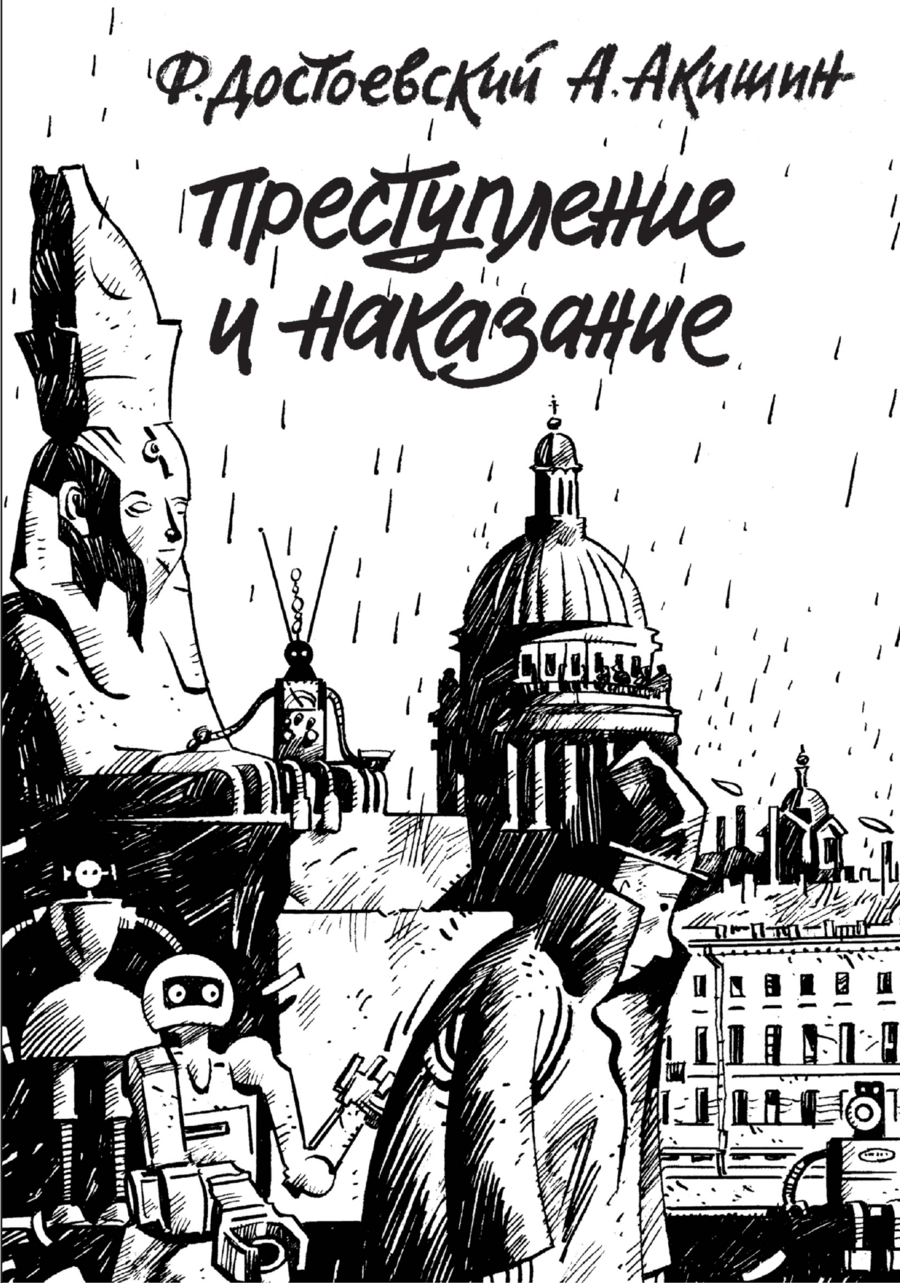
Crime and Punishment. Cover Art. E-book edition. KomFederatsiya Publishing.
Barely three weeks ago, I heard this name during lectures on the history of European and Russian comics. The discussion was about early Russian comics, and my thoughts latched onto the idea that Akishin is the only cartoonist from that era who remains relevant to this day. This research stems directly from those musings, and it is here that I intend to answer this question:
How did Askol’d Akishin, author of «the lost generation» of creators, manage to «not get lost» and continue to create and publish?
NOTE
It should be stated upfront that although the research will frequently touch upon the cartoonist’s biography, his work «My Comic Biography» will not be used for its analysis. Unfortunately, this book is not currently available for retail purchase, so I have not had the opportunity to read it.
My comic biography. Cover art. Bumkniga Publishing. 2013.
My Comic Biography. Pages 1–3. Bumkniga Publishing. 2013.
WHAT SETS THE AUTHOR APART?
Before delving into the past, we want to focus on the present and examine what makes Akishin’s books stand out from the other titles on the shelves of modern bookstores.
Immediately noticeable is the author’s recognizable visual style. Askol’d stated in an interview that he values the visual aspect most in comics, which makes him more of an artist than a comic creator.
Akishin most often works in line art because, as he admitted himself, he «is not fond of color.» He does not use graphics tablets, light tables, or other modern tools to ease his work; instead, he uses a pencil and then a pen and ink. In my view, this conservatism in his approach to work is what shapes a significant part of the author’s visual identity.
Business Trip. Boom Book. 2017.
Forest. Pop-up Book. 2015.
When creating their work, the artist is also inspired by the pieces of Gustave Doré and Italian graphic artists.
Gustave Doré. DEATH OF KORAH DATHAN AND ABIRAM; NAOMI AND HER DAUGHTER-IN-LAW; JOSHUA SPARES RAHAB.
Ugo Pratt. Favola di Venezia — Sirat al Bunduqiyyah. 1979.
Sergio Toppi. Sharaz. 1979.
Another characteristic of the author is their engagement with Russian classical literature and its authors. This ranges from direct adaptations into
George Dante. An Amazing Time Traveler. Comilfo. 2016.
My name is Gumilev. Graduated 2020.
HISTORY OF CREATIVE SUCCESSES
To be remembered, you must first be known.
For Askol’d, the opportunity to make a name for himself came through his involvement with the «COM comic studio.» Even without a fully established market, the studio’s creators released numerous diverse comics and managed to build a reputation. But there were many artists in the studio. What set Akishin apart? Primarily, his passion for horror stories. Horror comics were not widely prevalent at that time, and Askol’d’s work—combining theme with his unique visual style—made it stand out among comics generally, and among the work produced by the COM studio.
Necropolis. Pages 3–4. 1990.
Necropolis. Pages 5–6. 1990.
Necropolis. Pages 7–8. 1990.
Furthermore, participating in the studio allowed Akishin to build numerous contacts both in Russia and abroad. Gradually, these connections led to the publication of the author’s work overseas.
Master and Margarita. French edition, cover. Actes Sud BD Publisher. 2005.