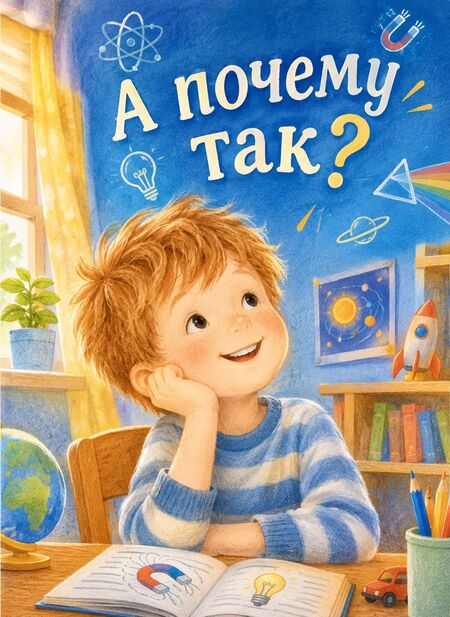
«Why is it like that?”—a children’s reference book that explains, in simple terms, how ordinary things around us work.
The Problem
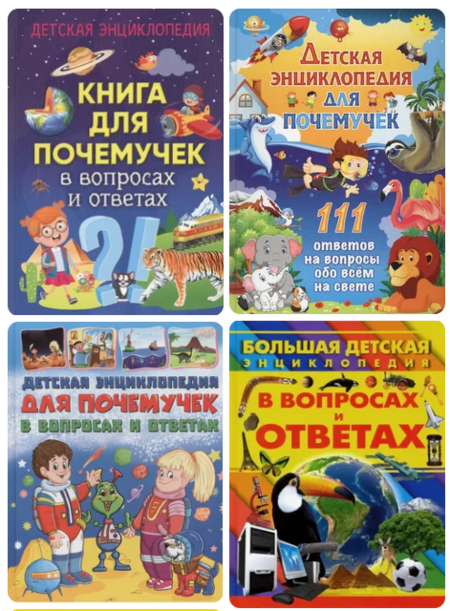
Kids ask many questions about what they see every day at home: «Why does water boil?», «How does the kettle know when to turn off?», «Why does ice float?». This is how they begin to understand how the world works. But adults don’t always know the answers, especially since many have long forgotten high school physics and chemistry. As a result, they resort to excuses like «That’s just how it is» or «You’ll understand when you grow up, ” or they search for answers on their phones, which are full of complex articles and long videos. Children’s encyclopedias tend to focus on distant topics, such as dinosaurs and space, rather than everyday items like kettles and lightbulbs.So what does this mean?
Ultimately, the child becomes accustomed to the world around them simply «working» on its own and stops asking how things are put together. Interest in the question, «How is this made?» gradually disappears. When they begin physics and chemistry in 7th or 8th grade—immediately with formulas and terminology—these subjects seem boring and incomprehensible, even though the child has seen all of it at home since childhood. If, during this time, their free time is spent on cartoons and videos, the real things around them remain unnoticed. The result is that the children lose their curiosity and the foundational basis for learning: they approach academic science without connecting it to real life.
Solution
The book, «Why Is It Like That?», explains physics and chemistry using things kids see every day at home: on kettles, light bulbs, refrigerators, and soda. Each question is given its own two-page spread, and they are all structured the same way: · A question the child asks themselves; · An answer delivered in 3–4 simple steps without complicated vocabulary; · A diagram showing what is happening inside the object.
The child comes to understand how the things around them work and continues to ask questions. The adult doesn’t need to recall school curriculum or search for an answer on their phone. They read together and learn something new side-by-side.
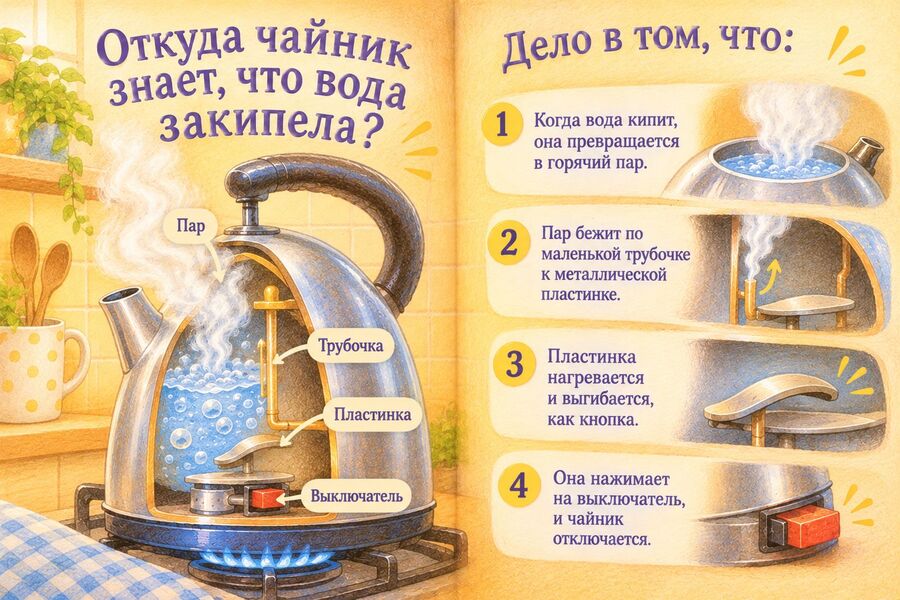
Spread Example
Format
· This is a children’s book for kids aged 6–10, meant to be read aloud with an adult. · The layout is consistent throughout: a large-font question and diagram on the left, and a multi-step answer on the right. The design is calm yet colorful, with large print and simple, cohesive illustrations.