
Introduction: brand description, positioning and target audience

Aviasales logo
Founded in 2007 by Russian entrepreneur Konstantin Kalinov, Aviasales is a flight metasearch brand specializing in finding affordable airline tickets and convenient travel deals. The brand is known for its strong focus on situational marketing, viral content, bold humor, and an ironic yet caring approach to travel.
Aviasales is the largest and most popular flight search engine in Russia and the CIS, but it positions itself not only as that, but as an independent media entity and a massive generator of viral content. The core promise is to offer a casual, humorous approach to the chaos of modern life and the complex planning of travel. This takes the brand out of the purely functional category, where the main arguments are search algorithms and cheap tickets, and brings it closer to the role of a trendsetter in situational marketing, specifically in the travel industry.

Aviaseys advertising poster
The brand’s core persona can be described as an ironic, slightly cynical, but ultimately caring travel buddy. In its communication, Aviasales deliberately avoids the polished, overly romanticized aesthetics typical of the travel industry. Instead, they rely on reactive marketing on their social media platforms, relying on bold humor, sarcasm, self-irony, and immediate responses to global news.This creates a strong sense of community and intimacy. The brand does not speak from a formal corporate pedestal, but rather engages with its users on an equal footing, rejecting traditional corporate communication practices.
The target audience is broad but coherent: primarily Millennials and Generation Z (roughly 18–35 years old), who travel independently and value their budget. Inside this group, several segments and characteristics matter most: active internet users who suffer from «add blindness» and actively avoid direct advertising. The target audience appreciates humor and is well-versed in meme culture. However, to attract new viewers, the brand penetrates into mainstream culture through viral advertising integrations and news, reaching almost everyone who regularly consumes daily internet content.
Communication channels
Thanks to its outstanding marketing strategy, according to the international web analytics system Similar Web, Russian air travelers visit Aviasales more often than any other travel website. Today, when people think about traveling or buying tickets, Aviasales is the first brand that comes to mind, achieving ultimate top-of-mind awareness. This success is heavily driven by a highly effective omnichannel strategy where each platform serves a specific functional or emotional purpose, precisely targeting different audience segments.
The core product acts as the purely rational channel where the actual transaction happens. The website interface is user-friendly, minimalist, and focuses entirely on price comparison and convenience. While the brand’s social media is loud and ironic, the app serves users who are already at the bottom of the marketing funnel, providing them with a quiet, efficient, and distraction-free environment to make a purchase.
Aviasales website and application
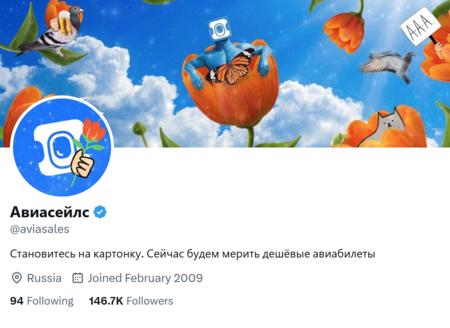
Telegram and X* (Twitter) platforms serve as the operational core for the brand’s signature situational marketing (*Telegram and X are owned by Meta, which is recognized as an extremist organization and banned in Russia). They target a fast-paced, news-savvy audience of Millennials and Gen Z who continuously monitor daily news feeds. On these platforms, Aviasales reacts lightning-fast to world events, political news, and pop culture with short cynical jokes. This demonstrates that the brand initiates interaction with its audience through witty jokes and remarks, prompting a quick response in the form of comments and shares. Ultimately, it is this communication that strengthens the brand community, united by a shared sense of humor.
Screenshots of posts from X*
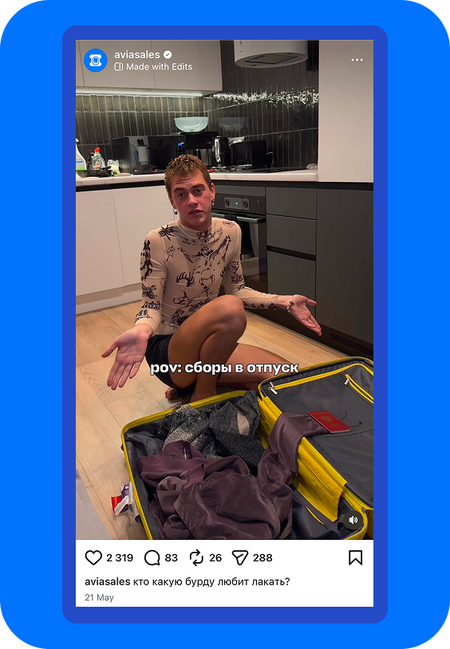
On Instagram*, the brand attracts a wider audience that is looking for everyday entertainment and travel inspiration (*Instagram is owned by Meta, which is recognized as an extremist organization and banned in Russia). However, instead of posting polished, glossy photos of resorts, Aviasales publishes engaging memes and relatable «travel pains» (e.g., struggling with oversized luggage, packing at the last minute). They also actively use interactive stories with polls and quizzes to communicate directly with subscribers. This approach works perfectly to keep the brand salient and emotionally close to the user, even when the user is not actively planning a trip.
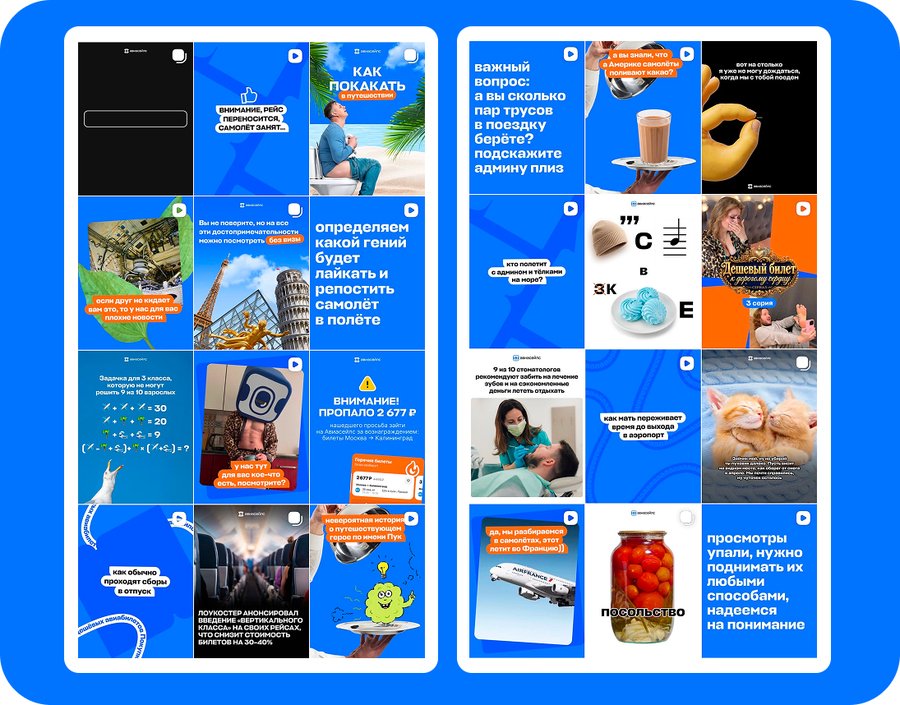
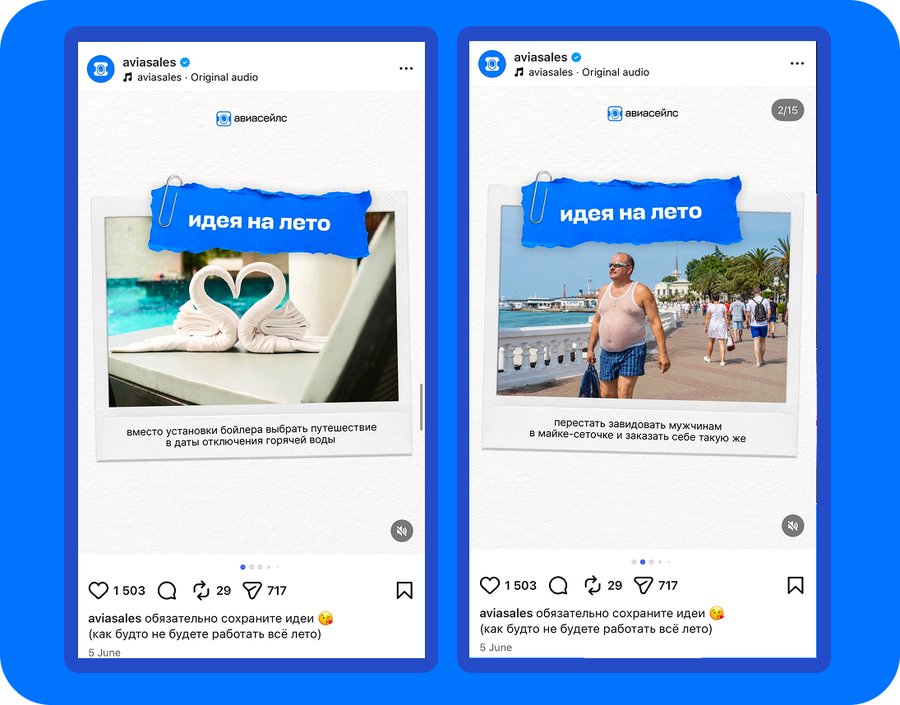
Aviasales posts on Instagram*
To attract the attention of the young Z generation and maintain high virality, the brand actively uses short vertical videos on TikTok, YouTube and Instagram*. Fast, native videos promote the brand through immediate emotional response, laughter, and engagement, without requiring deep cognitive effort from the viewer.
PR and Influencer Marketing
Aviasales is known for its large-scale and highly creative integrations with leading YouTubers and bloggers, as well as various shows, both on social media and on television (for example, Aviasales' advertising integration with the «Yu» TV channel and the show «Pregnant at 16»). This channel allows the brand to reach diverse secondary audiences, segmented by the specific influencer’s fanbase. Instead of using standard, boring ad reads, the brand encourages creators to integrate Aviasales into their content natively through dedicated comedy sketches, absurd jokes, and running gags.
This native approach ensures that viewers do not skip the advertisement, perceiving it as a seamless and entertaining part of the blogger’s video, thus building a strong, positive association with the brand.
Theoretical framework
Two theories are most relevant here: Uses and Gratifications Theory (UGT) and Symbolic Convergence Theory (SCT).
Uses and Gratifications Theory (UGT), developed by Elihu Katz, Jay Blumler, and Michael Gurevitch, assumes that audiences are not passive consumers, but active participants who deliberately choose media to satisfy specific needs. People use media for Diversion (escape from routine), Personal Relationships (social utility), Personal Identity (value reinforcement), and Surveillance (information). In Aviasales’ communication, this means the brand shifts its focus from merely fulfilling a rational, utilitarian need (finding and buying tickets, which falls under Surveillance) to satisfying deep emotional needs. The brand’s social media platforms are designed primarily for Diversion and Personal Relationships—users intentionally visit their channels for entertainment, stress relief, and to find witty memes they can share with friends, rather than to make an immediate purchase.
Symbolic Convergence Theory (SCT), developed by Ernest Bormann, explains how sharing common group fantasies creates a strong sense of community and group consciousness. Through «dramatizing messages"—such as jokes, metaphors, and specific narratives—individuals' private symbol worlds converge, creating a shared reality and a cohesive «Rhetorical Vision.» For Aviasales, this strategy unfolds by constantly generating sarcastic jokes about relatable travel pains, absurd news, and airline bureaucracy. By doing so, the brand creates a symbolic «we» (the savvy, ironic travelers who «get the joke»). This transforms ordinary followers into a highly engaged «in-group» united by a shared, humorous worldview, where the brand acts as a charismatic group member rather than a corporate entity.
Aviasales advertising campaign for the opening of a beach in Sochi, 2024
UGT usage analysis: why do people follow a ticket aggregator?
According to the Uses and Gratifications Theory (UGT), people engage with media to fulfill specific desires. In a traditional sense, a user should only visit a flight aggregator’s page when they need to buy a ticket, which satisfies the surveillance (utilitarian/informative) need. However, Aviasales has completely hacked this paradigm. They have transformed a purely functional service into a daily content provider, deliberately focusing on two distinct UGT categories: distraction and personal relationships. This is why Aviasales actively comments on the posts and videos of other ordinary social media users.
Aviasales comments on social media
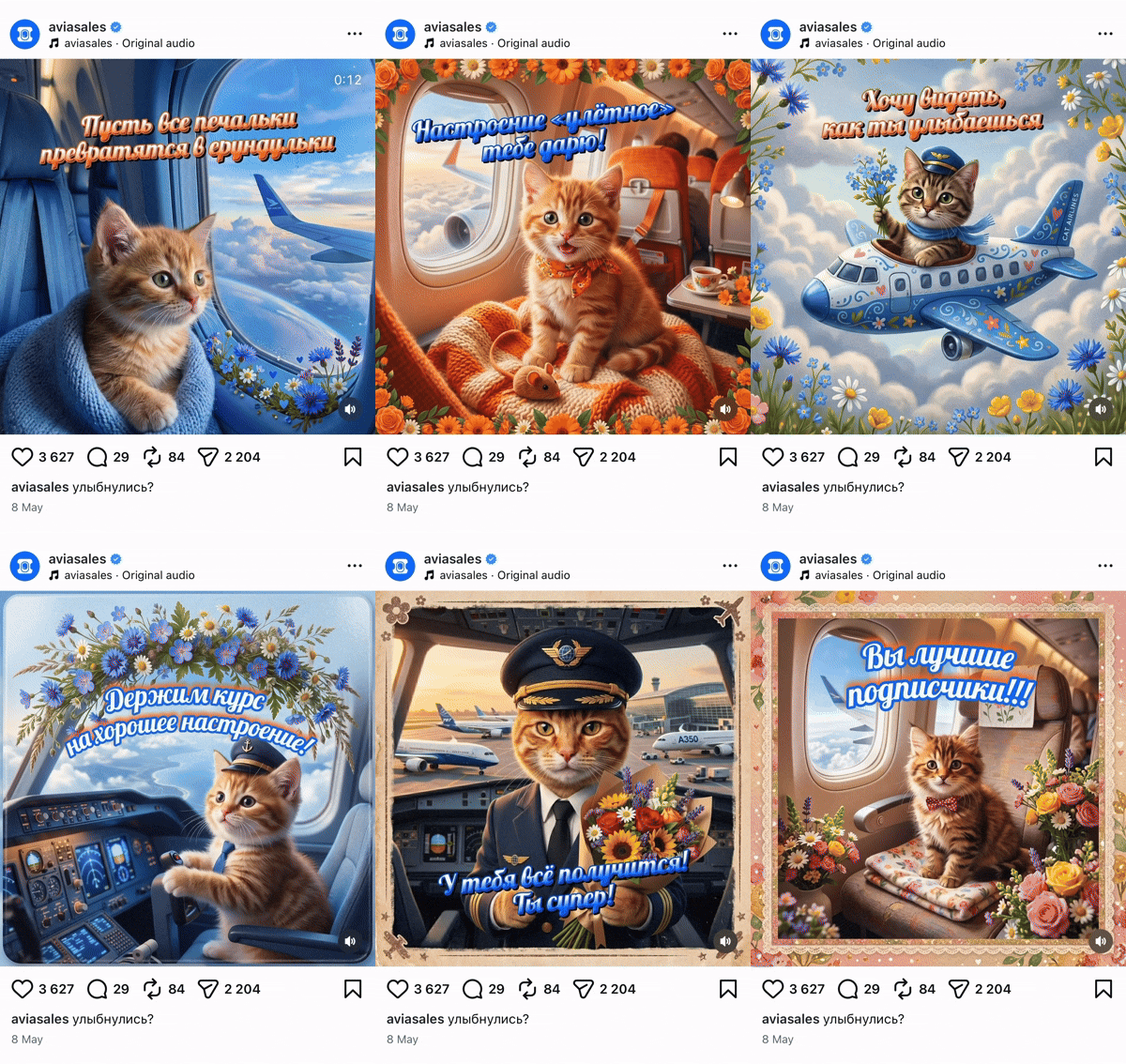
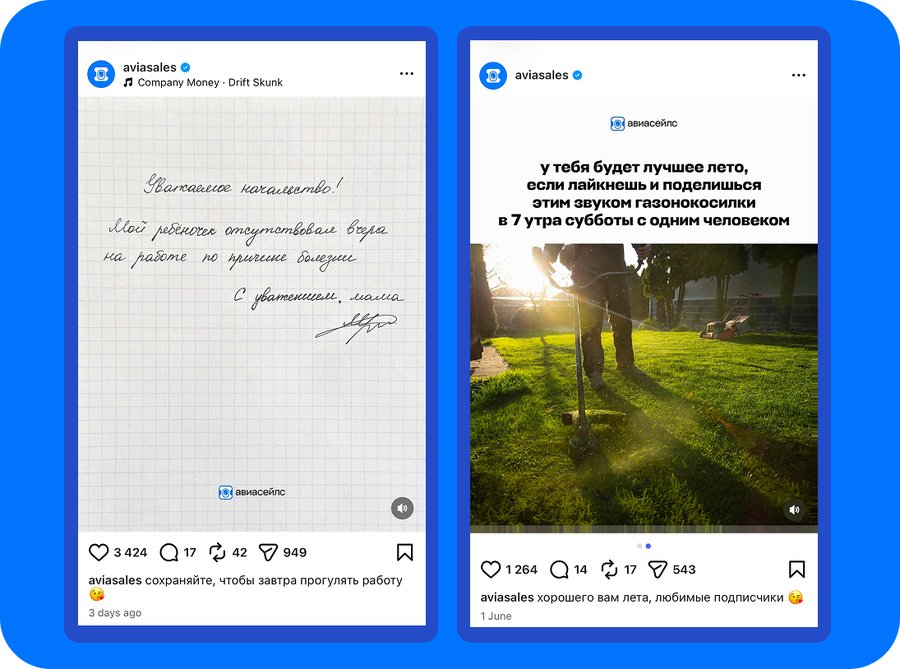
As for Entertainment (escapism and fun), Aviasales provides emotional release. Users subscribe to the Aviasales Telegram* channel or Instagram* to laugh, not to buy tickets. By constantly posting high-quality memes, absurd jokes on various topics, and nostalgic, ironic Viber-style postcards wishing «Have a Happy Day,» Aviasales satisfies users' need for distraction from their daily routines. The brand understands that the current news agenda can be overwhelming and offers a comfortable, humorous space. Instead of a direct call to action, such as «Buy tickets to Dubai», they sell emotions through jokes about the desire to travel anywhere to recharge, encouraging the audience to spend their free time interacting with the Aviasales account.
Aviasales' Instagram* post
Regarding Personal Relationships (social integration), their content is designed to be easily shared and acts as «social currency». When a user forwards an Aviasales meme or a relatable video (e.g., «POV: packing a suitcase») to a friend, they are using the brand’s content as a tool to build their own interpersonal relationships and gain social approval. The brand seamlessly integrates into the user’s daily peer-to-peer communication. People use Aviasales' jokes to say, «This is so us!» without needing to formulate the joke themselves.
Aviasales' Instagram* post
For example, in one of its Instagram* posts, Aviasales used the hype surrounding the recent MetGal to create its own situational reactive marketing: adapting the star’s outfits to various travel-related situations.


Aviasales' Instagram* posts