

1-indroduction
Brand history & key business model

Pop Mart is a Chinese company whose core business model revolves around selling blind boxes.
The company was founded in 2010 by Wang Ning, a Chinese entrepreneur whose net worth as of early 2025 was $22.3 billion, according to Forbes. The initial idea was to replicate the model of LOG-ON, a retail chain selling lifestyle products and accessories. Originally, Pop Mart did the same: their offline stores carried everyday stationery, small toys, gadgets, and cosmetics — with no figurines in sight. The only investor interested in growing the business was drawn to the offline factor; Wang Ning received rejections from others because the business model wasn’t exclusive or compelling, and in their opinion, the entrepreneur himself lacked the necessary skills.
The brand’s story changed drastically when Sonny Angel dolls began appearing on store shelves. People showed strong interest in these products, and the dolls generated the most profit. This led to a shift in the business model and the identification of their target audience.
1-indroduction
Brand positioning
Pop Mart positions itself as a creator of emotional experiences and a cultural phenomenon.
Four main aspects of the brand can be identified:
- Psychological comfort - Game mechanics - Status symbol - Exclusivity

Limited-edition toys become an emotional remedy for anxiety; acquiring them mimics a game mechanic — specifically, a slot machine — and the chance of getting a rare item is like winning a lottery ticket. Moreover, within their own world, these items serve as a solid currency: they can be traded or resold at higher prices, which vary based on trends, year of release, and edition size.
1-indroduction
Target audience
The primary target audience is people aged 18 to 29, 75% — women.
Their main qualities are:
- Self-reward (selfish consumption) - Motivations: emotions (excitement, surprise, joy from «winning»); social belonging; collecting - Low price sensitivity — they are willing to spend significant amounts on figurines - Levels of engagement: Casual buyers, Collectors, Community members, Investors/Speculators
POPMART | SKULLPANDA Series Pkush Doll Pendant
1-indroduction
Communication channels
- Social media: TikTok, YouTube, Instagram, Reddit - Collaborations with artists and global brands - Events, offline locations, designer toy exhibitions - NFTs (digital collectibles) - Global sales reach (global expansion)
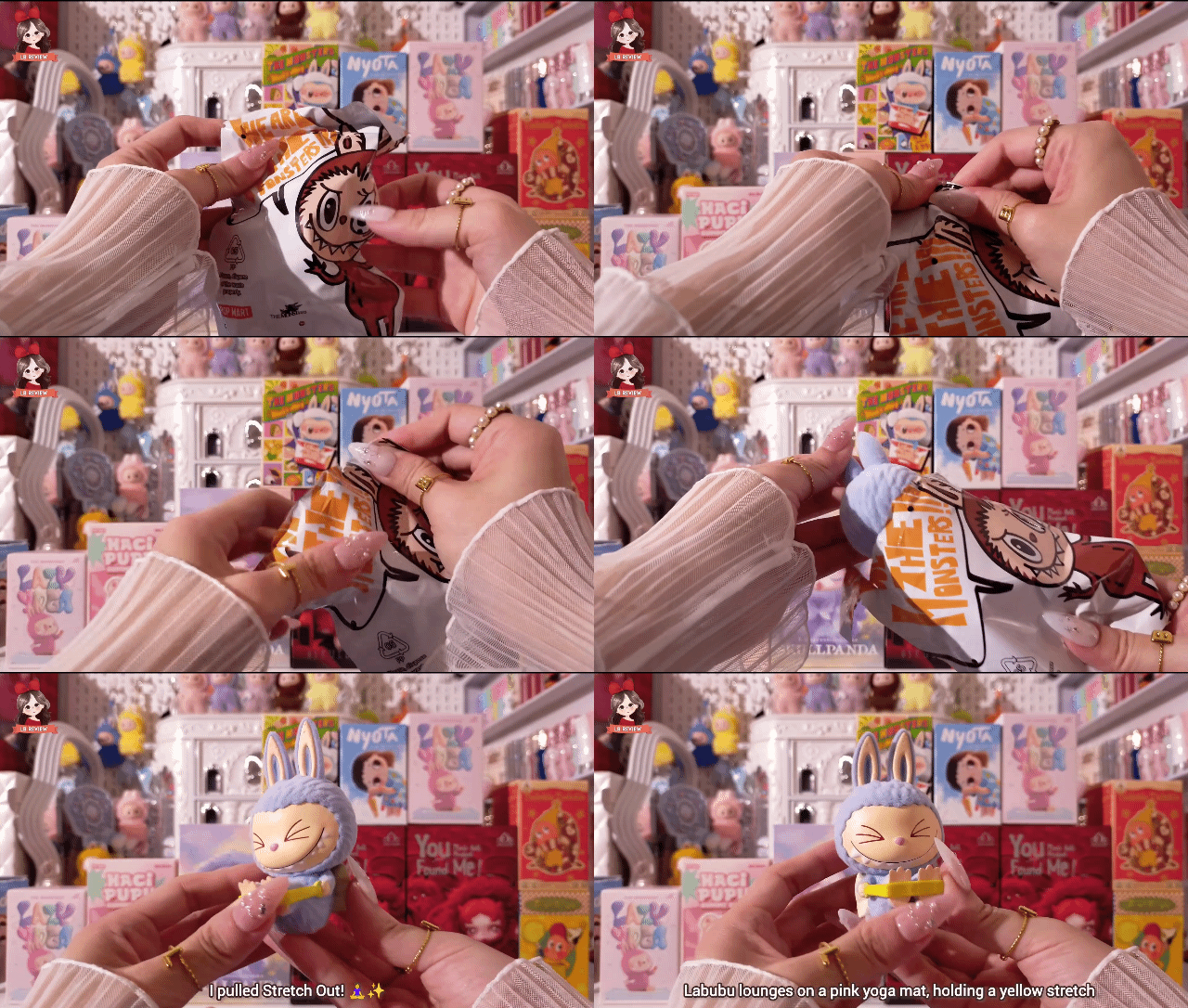
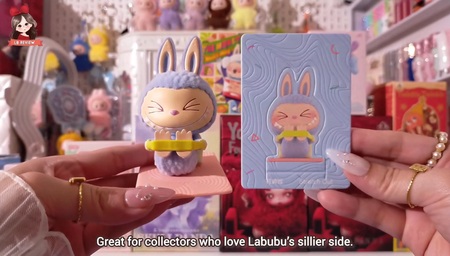
ASMR POPMART Blind Box Unboxing
The brand’s communication is built on a multi-channel approach, with social media at its core. Pop Mart has almost no traditional advertising; audience engagement happens through dialogue and demonstration — for example, unboxings or viral videos that attract users and play with their interest and attention. Primary points of contact occur through influencer marketing, where the connection with the audience feels much closer.
In addition, community contact also happens outside the brand itself. People create their own local fan communities and discussions, forming a community that, as a separate mechanism, still works in the brand’s favor.
Collaborations with artists and global brands attract significant attention because they play two cards at once: exclusivity through the stylistic features of artists and their individual approaches, as well as a sense of connection to already popular things when working with other brands — whose target audience may even differ slightly from Pop Mart’s, thereby elevating the brand to a new level.
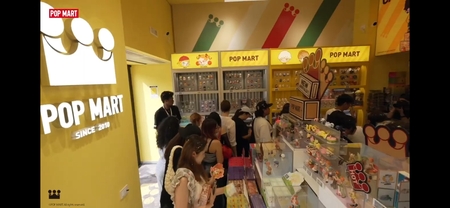


POPMART Milan store
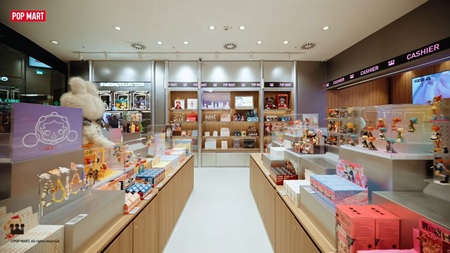
Offline events are also important, especially since we are dealing with physical objects and ownership. Stores serve as showrooms that capture visitors' attention. A certain museum-like quality works through visual imagery and adds a greater sense of belonging and engagement for the viewer. For today’s audience, the offline shopping process becomes a ritual, especially when it comes to «secrets» and «winning» (blind boxes); people want direct, real-time interaction with the object. Moreover, events, for example, involve changing setups that occur only at offline locations, adding exclusivity to the place itself through constantly changing visuals — people will want to come see and take part in an event that has a time limit.
Although Pop Mart primarily offers physical items, they are also evolving in the online world. Like many modern brands, they have NFTs, though much less emphasis is placed on them.
The brand’s popularity has led to its global expansion. The opportunity to purchase original toys has spread to many parts of the world — online and offline purchases, on marketplaces and in regular stores. Figurines have begun appearing everywhere, attracting even more attention. Even club membership has become available in different countries. Although the loyalty system may differ from place to place, the very fact that it exists and is used outside the brand’s home country speaks to its necessity and demand.
POPMART | SKULLPANDA
2-theoretical basis
First srategy Rhetoric of image + Uses & Gratifications
Uses and gratifications theory — is the study of the interaction of the audience with the media. The main idea of this theory is based on the fact that media users are not just passive consumers of content, but are active participants in choosing their preferred media in accordance with their desires and needs.
The prerequisites for the creation of the theory have existed for a long time, but for the first time it was officially formulated on paper by scientist Elihu Katz in 1974. Then he made the assumption that people choose the media that suits them and that the platforms themselves have no influence on them. Later, his colleague Jay Blumer co-authored the book «The Uses of mass communications: current perspectives on gratifications research» which outlined the basics.
A list of the five basic needs that media satisfies according to the theory of Uses and gratifications theory:
Cognitive needs. A person strives to be aware of events and have an idea of the things around them.
Emotional needs. When a person lacks certain emotional experiences, they satisfy them through the media.
Integrative needs. The need to gain confidence, status, or authority.
Social integrative needs. The basic human needs are to be surrounded by loved ones, to have a connection with family and friends.
The need for stress relief. Relaxation, rest.
The theory puts forward the following basic concepts:
— People use mass media purposefully to satisfy a set of their needs; each user has their own motivation to consume a particular content.
— The media does not influence people, but on the contrary: active users influence the media content being created.
— Media platforms actively compete with other ways of meeting needs, such as personal communications. During the period of information development of society and the Internet, this competition becomes more noticeable.
— Consumers are rationally aware of their needs.
— The importance of a particular media in the communication environment depends on the preferences and mood of the audience.
The growth of this theory has led to the emergence of a new theory of communication studies, which believes that people become most dependent on the media that best meets their needs. This theory is called dependency theory. Thus, it is possible to trace the trends of the most popular media, and understand which needs are most in demand for people in certain historical periods.
2-theoretical basis
Second strategy Two-way symmetrical PR + Dialogic theory
Building relationships is one of the primary tasks of public relations specialists. The theory of dialogue is one of the oldest foundations of communication with society. To briefly describe its principle, it says that building contact between the organization and the public through the exchange of ideas and opinions makes it easier to achieve the organization’s goals. This principle puts the concept of a dialogic system more important than a monologue policy.
Here are the five fundamental principles of dialog:
Mutuality. Appeals to the fact that the organization and the public are interconnected. The main factor is voluntary cooperation.
Propinquity. Here it is understood as the willingness of the parties to an open exchange of views. The organization should listen and consult with the public about making decisions on a particular issue, when the public should be ready to give feedback.
Empathy. Empathy and support. This implies, firstly, creating an atmosphere of trust for the audience, and secondly, the design of platforms for exchanging opinions should be fairly easy and accessible to all interested participants.
Risk. The principle is based on the fact that each side of the relationship has certain risks associated with the unpredictability of public relations. The participants in the dialogue are vulnerable due to the appeal of information, which is a significant force in the information period of development. Also, communication can never go according to a pre-written plan, which entails the risks of unforeseen consequences.
Commitment. The participants in the dialogue should make the most of each other. Honesty and willingness to put aside your differences in order to make maximum progress are important here. Each side should be ready for dialogue and want to find a common solution.