Terminology
Cosplay is a combination of the words «costume» and «play». It refers to the practice of dressing up as a character from a movie, television show, comic book, video game, or other form of media. It is often a social activity, with many enthusiasts participating in conventions, competitions, and online forums.
Cosplay grew in popularity in Japan during the 1980s and 1990s, especially with the rise of anime and manga culture. Events such as the Anime Expo in the United States began to emerge, providing platforms for cosplay enthusiasts to showcase their costumes. By the 2000s, cosplay had become a global phenomenon, spreading far beyond Japan.
«Muslims are strangers. We can’t fit into every single setting.»
Eventually, cosplay became popular in Muslim-majority countries such as Malaysia and Turkey.
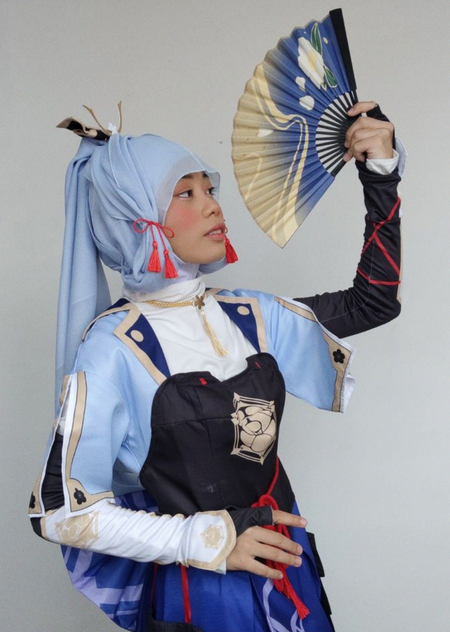
Many young muslim men and women were interested in participating, wanting to incorporate and show their beliefs while doing their new hobby: «Hijab cosplay combines the elegance of modest fashion with the creativity of cosplay. One notable difference between hijab cosplay and traditional cosplay is the use of hijabs instead of wigs. The hijab, a garment worn by many Muslim women, is not only a beautiful symbol of modesty, but also a canvas for creative expression». © Mumu Alpaka
Many saw their beliefs not as a limitation, but as an opportunity to show the wider community the charming aesthetics of modesty and flowing fabrics. Hijab cosplay quickly attracted the interest of non-Muslims for its beautiful ornamentation and elegance, as well as other Muslim teens, who often say it makes them feel represented.
Cosplay is practiced by followers of the Sunni branch of Islam, and it’s not just wearing hijab, which is expected of youth, but modest, covering your ankles, neck, arms and shoulders. People also avoid cosplaying fictional deities, which clashes with their values.
History
Theater was not really widespread in early and medieval Islam. There were puppet shows and shadow plays, and very often the puppets had holes to show that they were not alive. Interest in drama and dance increased in the Ottoman Empire, influenced by European countries. Acting was still controversial at the beginning of the 20th century and was often shunned and persecuted.
However, in many Eastern countries that later adopted Islam as their main religion, there was a practice of theater and opera in pre-Islamic times, such as Bangsawan. These countries did not choose to forget their traditions, but to incorporate them into their new religion.
Even today, theater, acting, and the pursuit of hobbies often face prejudice.
«Ok, what is she gonna do? Which genre is she gonna play in that has no haram? How is she gonna have a stable career in such a non existing niche of television? Why would anyone take HER instead of plenty other, more talented people?»
«How is such a career proper for a Muslimah? What real world usefulness does she offer by pursuing this career?
Whole bunch of nonsense. Even as a non Muslim, becoming an actor is just crap. And as a Muslim, our standards are much higher than this toxic and haram acting environment.»
«What’s more likely is that she’ll be told to take off her hijab for better roles. She’ll also be the odd one out and stick out like a sore thumb in a typical theatre school setting, forget even getting into the industry. It’s just not realistic.»
Cosplay
Ayame Yuina as Fujiwara Chika from Kaguya-sama: Love is War!
Rainy Isabella as Kamisato Ayaka from Genshin Impact
Lovely Amizah as Springbloom Missive Kamisato Ayaka from Genshin impact
«The hijab made me who I am today. It has been my armour against the harsh world, it has kept me safe from bad company and from making bad decisions.» © Hijabi Hoo
A group cosplaying main characters from web animated show RWBY.
Hijabi Hoo as Captain America
Nico Rofy as Violet Evergarden
@ai_nurul_ and Nina as Hatsune Miku
«Thanks to God, there are also many who support hijab cosplay communities, both at home and abroad.» © Ange Minami
«Sometimes I think about how we can do our hobby while staying positive about it so that fellow cosplayers can express their creativity.» ©
@MiisaMHC as Gawr Gura from Hololive
Ai Nurul as Wednesday Addams from Wednesday the TV show
@shay.vanes as Raiden Shogun from Genshin Impact
Ange Minami as Mordred from Fate/Grand Order
Rainy Isabella as Sigewinne from Genshin Impact
Rainy Isabella as Mitsuri Kanroji from Demon Slayer
@queenofluna inspired by Junji Ito’s Uzumaki manga
@queenofluna as Queen Elsa from Frozen 2
J-Fashion
J-Fashion refers to a wide range of Japanese street fashion styles that emerged in the late 20th century. The term encompasses various subcultures and aesthetics that are heavily influenced by Japanese youth culture, anime, manga, and music. J-Fashion is known for its creativity, individualism, and the way it blends traditional Japanese elements with modern trends.
@ozz_sinjuku
@aliceberrybum
Chihaya Bibi @chibibie