Concept
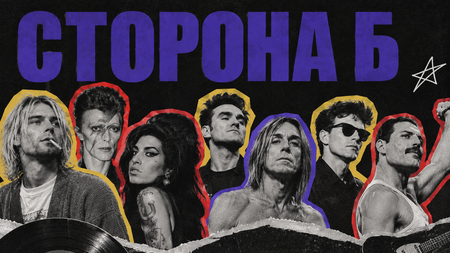
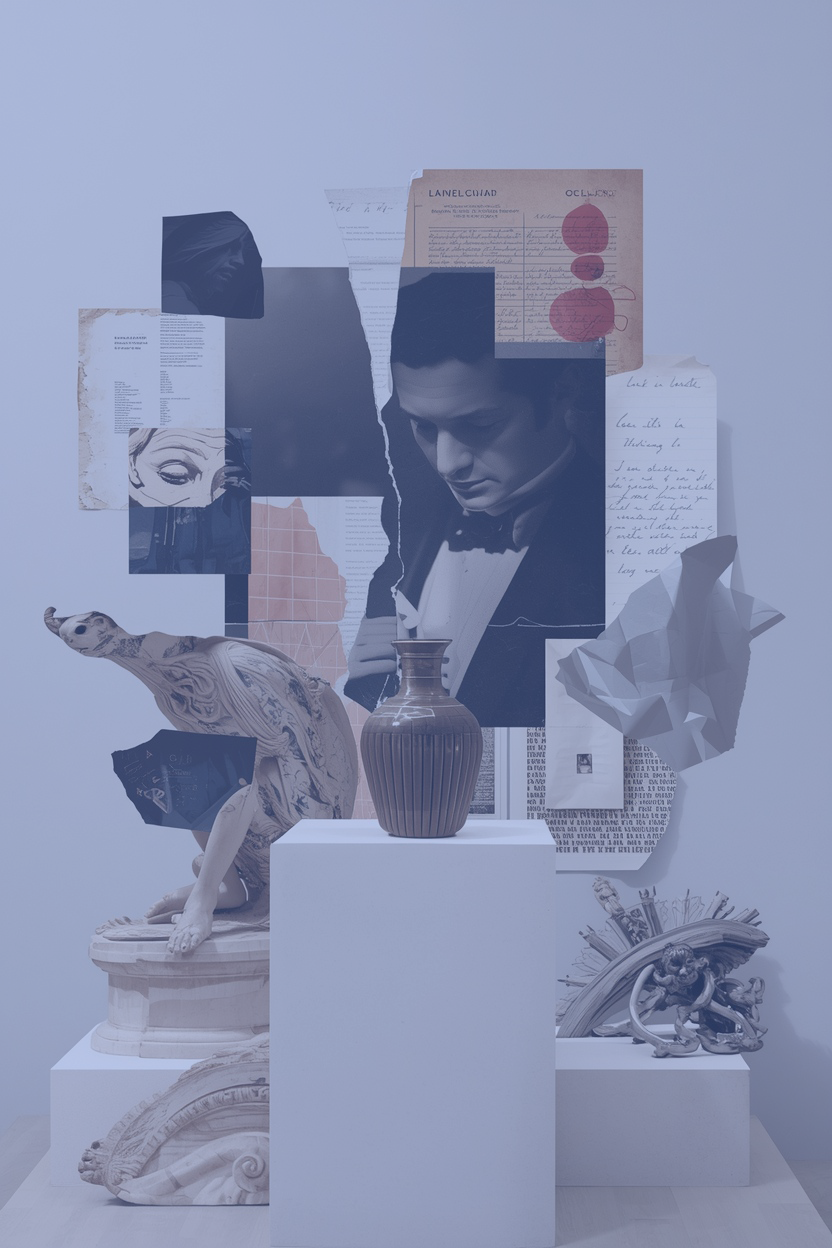
«NOT SO» is a media outlet focused on artistic experiments of the 20th and 21st centuries—the ideas that initially seemed flawed, and what emerged from them. We explore the experimental artistic practices of the 20th and 21st centuries that disrupted traditional notions of the artwork, and we test what happens if we re-execute them today using modern technologies and AI.
Data Sources
For «NOT SO» (or «NOT RIGHT»), it is essential to use not only art information resources but also archives of works, scientific research, generation tools, and audience feedback.
Sources are divided into 3 groups.
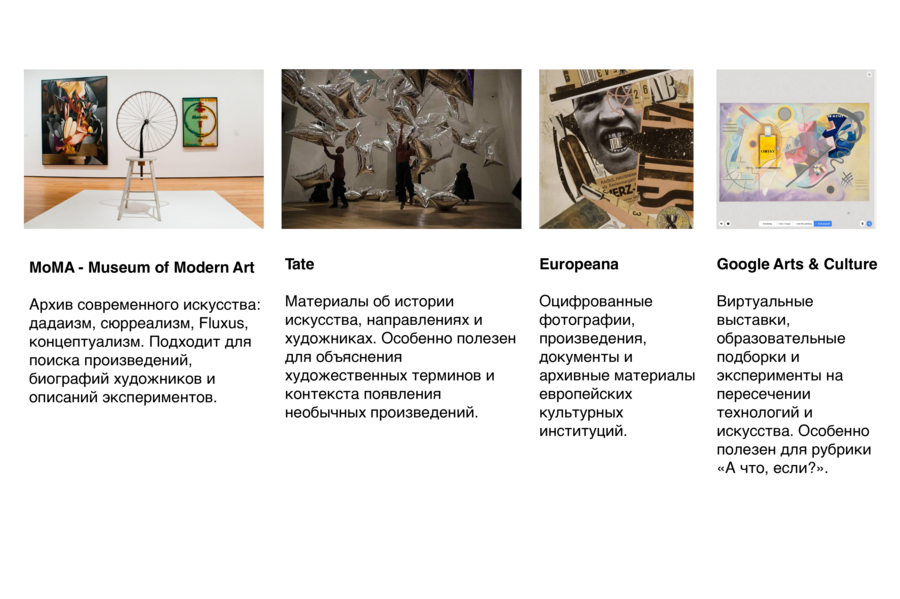
1. Museum Archives and Educational Platforms This is the primary source for vetted historical data, artworks, and descriptions of artistic practices.
2. Scholarly and Research Resources— Google Scholar — academic articles on the avant-garde, conceptual art, and the influence of technology on creativity. — JSTOR — research on art history, critical texts, and archival publications. — Getty Research Institute — studies, documents, and archival materials related to art.
3. Sources for Visual and Experimental Content— Wikimedia Commons — Image search for works with specified usage conditions — Openverse — Image search with open licenses — Experiments with Google — Examples of contemporary technological and artistic experiments — Generative AI Tools — Creation of your own visualizations, collages, and modern interpretations
Division of Human and Machine Processing
Guidelines for Automated Services
To complete the work, we suggest utilizing several AI services, each with distinct functionalities. Each service will receive a specific task, initial data, and constraints.
1. AI Researcher for Information Search and AnalysisObjective: To locate information regarding artistic experiments and transform it into a structured knowledge base.Guidelines:
- Search materials primarily in museum, archive, and academic sources.
- For every historical fact, retain a link to the source.
- Identify five elements: the rule, its violation, the societal reaction, the consequences, and the possibility of repetition today.
- Do not fabricate quotes, dates, artwork titles, or contemporary reactions.
- Note any unverified information and submit it to the editor.Deliverable: A research card detailing an artistic experiment, complete with facts, sources, and publication ideas.
2. AI Text Generation EditorObjective: To transform research materials into Telegram posts using the «NOT LIKE THIS» style.Working Guidelines:
- Begin the post with a provocative question, an unexpected fact, or an artistic conflict.
- Use accessible, engaging language, avoiding complex academic jargon.
- Explain which rule the artist violated and why that violation was noteworthy.
- Do not recount the artist’s entire biography; instead, focus on the experiment.
- Conclude the post with a question that prompts the audience to reflect.
- Do not present subjective interpretations of art as objective facts.Deliverable: A draft Telegram post, approximately 800–1500 characters in length, adapted for the chosen segment. The length may vary depending on the format.
3. AI Artist for Generating Visual ExperimentsObjective: To create modern interpretations of historical artistic experiments.Guidelines:
- Maintain the core principle of the historical experiment, rather than merely copying the external style of the work.
- Utilize contemporary technologies, materials, and cultural contexts.
- Generate several visual outcome variations for the editor to choose from.
- Preserve the prompt used and details about the generation model.
- Do not present the AI generation as an authentic historical work.
- For the «Human VS AI» section, ensure consistent experimental conditions.Deliverable: 2–3 variations of the visual experiment, complete with an idea description and prompts.
4. AI Fact-Checker for Quality AssuranceTask: To verify prepared materials before submission to the editor.Workflow Rules:
- Cross-reference dates, names, titles, and historical events with provided sources.
- Check if the text aligns with the designated section.
- Identify unverified claims and potential AI fabrications.
- Verify that the contemporary experiment does not contradict the historical artistic concept.
- Check for information regarding the origin and usage rights of images.
- Escalate disputed cases to a human reviewer rather than correcting facts based on assumptions.Deliverable: A verified draft and a list of notes for the editor.
5. AI Analyst and Publishing Planner Task: Automate content publication and analyze feedback.Guidelines:
- Publish only materials marked with the status «Editor Approved.»
- Adhere to the approved content plan: two topics per month, five publications for each topic.
- Collect available statistics on views, reactions, and polls.
- Identify the topics and formats with the highest engagement.
- Propose ideas for future experiments to the editor based on audience interests.
- Do not alter the approved editorial concept independently.Outcome: Scheduled publications, statistics, and recommendations for the next content plan.
Each of the five «NOT RIGHT» categories requires a unique approach to automation.
«NOT SO» will function as a small, experimental iteration where AI handles the search, preparation, generation, and analysis of information, while the human is responsible for the artistic concept, critical thinking, and quality control. The main feature is that the artificial intelligence here does not just produce media content—it becomes the subject of investigation: can it replicate the creative experiments of past artists and propose something genuinely new?