Navigator
1. Introduction: The Paradox of Beautiful Horror
2. Theoretical Framework: The Sublime, Aestheticization, and the Ethics of Gaze
3. Painting: From the Sublime Landscape of Catastrophes to the Anti-Beauty of War
4. Photography: The Beauty of Documentation
5. Film: Beauty as Language and as Trap
6. What Beauty Does to Our Relationship with an Event
7. Conclusions
Research Concept
This study examines the paradox of a beautiful depiction of a terrifying event: why a catastrophe in painting, photography, and cinema can elicit admiration, and how this impacts our relationship to another person’s tragedy.
Hypothesis: Beauty simultaneously captures attention while creating a safe distance. It can help viewers perceive the event, transform it into a spectacle, or provide grounds for critical analysis.
Methodology—a comparison of 36 visual examples across light, color, composition, scale, point of view, and the presence of people. The objective is to understand where the form directs the viewer’s gaze.
Three Research Questions
1. What techniques make the frightening beautiful: composition, light, color, scale, point of view?
2. Who uses them and why: the romantic artist, the war photographer, the director?
3. What happens to the viewer: empathy, numbness, pleasure, or a sense of guilt?
A visual investigation into the aestheticization of catastrophe in painting, documentary photography, and cinema.
The beauty found in depicting catastrophe functions as a double agent. It draws and holds the gaze, yet simultaneously creates distance, shifting focus from the people to the form. This study examines when beauty aids in understanding an event, and when it substitutes for it.
The work compares composition, light, color, scale, and point of view. Seven sections and 36 visual examples.
1. Introduction: The Paradox of Beautiful Terror
A fire, a storm, an explosion, the ruins of a city in a painting, a photograph, or a frame often look in such a way that we want to look at them, rather than turn away. Fire provides a warm palette, smoke creates depth, and ruined architecture resembles monumental sculpture. As early as 1757, Edmund Burke wrote that danger viewed from a safe distance generates a particular pleasure. This leads to a paradox: the image conveys someone else’s misfortune, yet the viewer experiences an aesthetic sensation. This work compares three media (painting, photography, and film) and addresses the question of how beauty influences our relationship to the event itself.
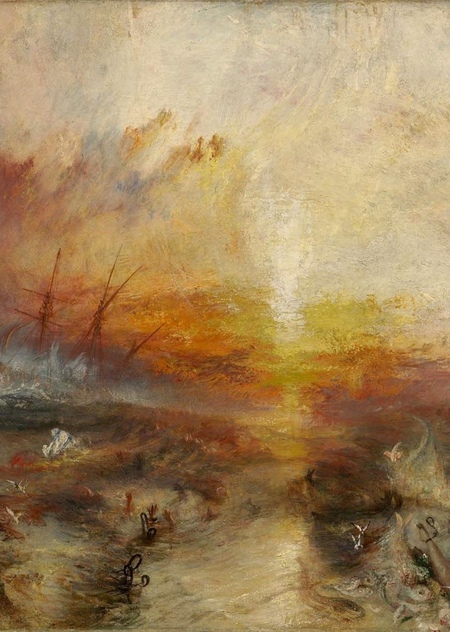
William Turner. Slaveship Ship. 1840. Museum of Fine Arts, Boston.
- Theoretical Framework
The idea that beauty and fear are connected is ancient. Lucretius, in the beginning of Book II of his poem On the Nature of Things, observes that it is pleasurable to watch from the shore those suffering in a shipwreck—not because one rejoices in the misery of another, but because one witnesses suffering from which oneself is spared. Hans Blumenberg transformed this image into the metaphor of the «shipwreck with the spectator» (1979). Burke (1757) and Kant (Critique of Judgment, 1790) described the sublime as the experience of power and threat from which we are protected by distance.
In the twentieth century, the focus shifted to ethics. Walter Benjamin, in the epilogue of his essay «The Work of Art in the Age of Mechanical Reproduction» (1935–1936), wrote that humanity has reached such a level of self-alienation that it can experience its own destruction as an aesthetic pleasure. This was prompted by Marinetti’s manifesto on the war in Ethiopia, set against Ernst Jünger’s reflections on warfare.
Susan Sontag, in On Photography (1977) and Shooting an Image of Suffering (2003), debates whether a beautiful photograph makes suffering attractive or whether the constant stream of such images dulls our compassion. Georges Didi-Huberman counters this criticism of aestheticizing suffering in his book Images malgré tout (2003): even an imperfect, «ugly» image is necessary because without it, the event vanishes from memory.
A separate thread relates to ruins: Ross Maccoley’s Pleasure of Ruins (1953), and contemporary debates surrounding «ruin porn”—beautiful photographs of ruined cities and abandoned buildings.

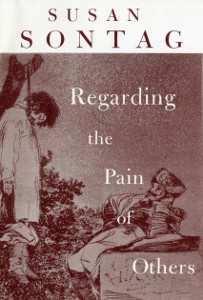
Left: Susan Sontag. On Photography. 1977. Cover of an English-language edition. Right: Susan Sontag. Watching the Misfortunes of Others. 2003. Cover of an English-language edition.


Left: Hans Blumenberg. Shipwreck with a Viewer. 1979. Cover of the German reprint. Right: Georges Didi-Huberman. Images Against All Odds. 2003. Cover of the French edition.
Théodore Géricault. The Raft of the Medusa. 1818–1819. Louvre, Paris.
3. Painting: From the Sublime Landscape of Catastrophe to the Anti-Aesthetics of War
In painting, the beauty of catastrophe coalesced in the 18th and 19th centuries within the tradition of the sublime landscape: immense scale, tiny figures, dramatic light, and warm flames set against a cold sky. The viewer observes this from a safe vantage point, and the elemental force appears magnificent. However, in the 19th and 20th centuries, a countercurrent emerged: artists intentionally stripped war of its beauty (Goya, Vereshchagin, Picasso) or showed how a beautiful landscape could be the trace of a massacre (Paul Nash).
The beauty of the elemental force
Joseph Wright from Derby. Vesuvius in eruption with a view of the islands of the Bay of Naples. c. 1776–1780. Tate, London.
J.M.W. Turner. Fire in the Chambers of Lords and Commons. 1834–1835.
John Martin. Great Day of Wrath. 1851–1853. Tate, London.
John Martin. The Destruction of Pompeii and Herculaneum. 1822. Tate, London.
Caspar David Friedrich. Frozen Sea. 1823–1824. Hamburg Kunsthalle.
Beauty Concealing Tragedy
In Turner’s «Slave Ship,» the golden sunset and the elements command the gaze, while human tragedy surfaces in the details. For Paul Nash, the beautiful landscape becomes the scar of war; for Huber Robert, ruins transform into a subject for aesthetic contemplation.
J. M. W. Turner. Slave Ship. 1840. Museum of Fine Arts, Boston.
Paul Nash. We are creating a new world. 1918. Imperial War Museum, London.
Hubert Robert. Imaginary View of the Louvre in Ruins. 1796. Louvre.
Beauty is not intentional
Goya, Vereshchagin, and Picasso present violence without glorification. Monochrome, mutilated bodies, and a pile of skulls make human loss the central subject of the image.
In painting, it is important to compare the light source, the distance to the event, the scale of the human figures, and the role of color: gold and crimson, or gray and black.
Francisco Goya. A grand masterpiece! With skeletons! Plate 39 from the series «The Horrors of War.» 1810–1820; published in 1863.
Vasily Vereshchagin. Apotheosis of War. 1871. Tretyakov Gallery.
Pablo Picasso. Guernica. 1937. Museo Reina Sofía, Madrid.
4. Photography: The Beauty of Documentation
Photography holds a unique position: it aspires to be a document, and for this reason, its beauty provokes more ethical debate than that found in painting. Salgado photographs the burning Kuwait after the Gulf War as a biblical landscape; Norfolk deliberately employs the language of the Romantic landscape and Victorian military photography; and Wall and Dell frame their shots according to the conventions of historical painting.
Zontag accused Salgado that the beauty of his images distracts from the causes of suffering, while defenders counter that it is precisely the beauty that compels people to pause. A specific case is the blurred images by Robert Capa from the Normandy landings, where «ugliness"—the blur and the grain—became a mark of authenticity.
The beauty of ruins and conflagrations
Sebastião Salgado. From the series «Kuwait: Desert in Fire.» 1991. © Sebastião Salgado.
Simon Norfolk. From the series «Afghanistan: Chronotope.» 2001–2002. © Simon Norfolk.
Joel Meyerowitz. From the series «Aftermath: World Trade Center.» 2001–2002. © Joel Meyerowitz.
Edward Burtynsky. Oil Spill #1, REM Forza, Gulf of Mexico, May 11, 2010. © Edward Burtynsky.
Robert Polidori. Classrooms in Kindergarten No. 7, Pripyat. 2001. From the project «Exclusion Zones.» © Robert Polidori.