Media Concept
Automated media covering unusual local events in Moscow, designed to help young people discover small, lesser-known happenings that don’t make it into major city guides.
The media collects information on creative workshops, intimate concerts, small exhibitions, gatherings, independent spaces, and other unconventional leisure activities from social media and organizer accounts.
The project is built on the concept of local discoveries: the user doesn’t select a specific event category, but rather what they feel like doing right now—trying something new, making something with their own hands, meeting people, or spending free time in an unusual way.
Data Sources for Media
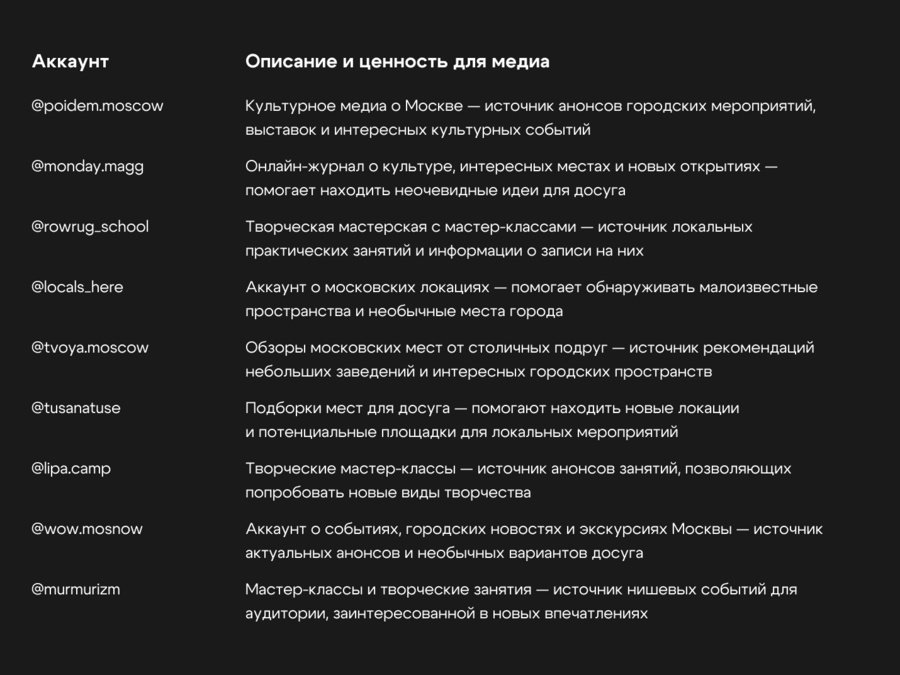
The primary data sources are Instagram accounts belonging to Moscow city media, local communities, creative workshops, and independent organizers. They post information about small events, unusual locations, and new leisure formats that may be of interest to the project’s audience.
Account Examples
Data schema divided into human and machine processing
The system is based on the sequential processing of information: from source selection to publishing verified events on Telegram.
Data structure of one event
For automation, every found event must be converted into a unified card.
If a field is absent in the source material, the AI must mark it as unknown rather than inventing a value.
Guidelines for Automated Services
Automation Technology
For machine processing, Claude is intended to be used with external sources connected via a Custom Connector and MCP (Model Context Protocol).
Proposed scenario:
- Create or connect an MCP server that has authorized access to the necessary Negrogram data.
- Add it to Claude via the Connectors / Custom Connector section, specifying the server address and configuring authorization.
- Provide Claude with a list of selected accounts and search criteria.
- Configure the analysis of available publications and the extraction of information on local events.
- Receive a structured summary of events with source links for subsequent editorial review.
Human Processing
- Building the Source Database. The editor independently searches for and adds accounts from city media outlets, local communities, workshops, and independent organizers.
- Analyzing and Selecting Sources. This involves checking the theme, regularity of publications, event geography, and alignment with the media’s concept.
- System Configuration. Defining search criteria, connecting available sources, and, if necessary, requesting permission from organizers to access and use information.
- Results Verification. Cross-referencing the found events with primary sources, and verifying dates, addresses, costs, registration requirements, and availability of spots, if that information is accessible.
- Editorial Approval. Selecting the most compelling findings, editing the text as necessary, and approving the publications.
Machine Processing
- Source Monitoring. The AI analyzes new publications from connected accounts with accessible data.
- Relevant Event Discovery. It highlights small, unique, and local events in Moscow, filtering out irrelevant content.
- Information Extraction. It identifies the event title, date, time, address, cost, event format, and a link to the original source.
- Summary Compilation. It gathers the discovered events into a single, structured table, flags missing information, and notes potential duplicates.
- Content Preparation. After review by an editor, it generates Telegram posts using templates for sections such as «Discovery of the Day, ” „Weekend Found, ” „I Feel Like…, ” and others.
- Publishing Queue. It saves the prepared posts as drafts.
Example task for Claude
Analyze the newly available publications from connected sources. Find small, unique local events in Moscow that have not yet concluded. Exclude mass events, promotional posts without a specific event, and duplicates. For each event, specify the name, a brief description, date and time, address, cost, registration link, a direct link to the source, and the reason why the event fits the concept of local finds. Do not invent missing information—mark it as «Not specified.» Return the results in a table and mark anything that requires manual review. Do not publish anything without editor approval.