
Concept
In game design, the concepts of power and authority are often confused, yet in practice, they represent entirely different modeling challenges. If power relates to coercion and resource control, authority is a social construct that reflects legitimacy, respect, and trustworthiness voluntarily recognized by other participants. J. Huizinga wrote that the game creates its own order—a «magic circle”—within which authority is drawn from the internal logic of the system, not from external force [4]. Historically, board games mirrored social hierarchies [5], but modern projects are transforming this approach: they invite players not just to obey the rules, but to independently construct relationships of trust and influence.
The relevance of this topic is driven by the growing interest in how games model complex social interactions.
M. Mattlin demonstrates how changes to the Diplomacy rules shift the game’s authority from Hobbesian anarchy toward constructive collaboration [2]. A. Herrero and colleagues emphasize that contemporary board games increasingly utilize mechanics designed to develop teamwork and social networking skills [1]. Serena Yang and her colleagues, analyzing COUP, document the «hatred scale» phenomenon—an emergent reputation that outweighs rational strategy [3]. However, the novelty of this research lies in the fact that most studies focus either on power as domination or on reputation as a negative penalty. Almost no one analyzes how a specific set of board game mechanics shapes the feeling of acquiring legitimacy and trust—as a positive, constructive force.
Goal of the Work — to identify the mechanisms through which the feeling of authority is modeled in modern board games.
Objectives:
1. To classify formal and emergent authority;
2. To analyze their influence on game dynamics using specific board games as examples.
Hypothesis: Authority in board games is successfully modeled not through direct coercion, but through mechanics of interdependence, delegated action, and social memory—rendering it more fragile, yet more significant for gameplay, than brute power.
Research methods include qualitative analysis of theoretical sources [2][3][4][5] and a comparative analysis of the mechanics of specific board games: Twilight Imperium, Root, Dead of Winter, Nemesis, Archipelago, Fallout (Hobby World), and Game of Thrones.
Topics:
1. Formal authority, established through asymmetric rules and political phases;
2. Emergent authority, arising in semi-cooperative and narrative games through social memory and reputation.
Emergence in game design is the emergence of complex, unpredictable situations arising from the interaction of simple game rules that the developer did not explicitly program.
Formal authority and asymmetry of rules
Political and territorial authority

In Twilight Imperium, the political phase is one of the central elements of game design that conveys a sense of authority. The player holding the «Speaker» token gains the formal right to propose laws for a vote and to vote last, which gives them a strategic advantage in tallying votes and forming coalitions. The trading mechanic requires the mutual consent of the parties involved, creating a branching network of interdependencies between factions. Consequently, the Speaker’s authority does not dictate decisions to other players; rather, it legitimizes the diplomatic process—their power is voluntarily recognized because it is based on the internal logic of the game world—that very «magic circle» described by Huizinga [4].
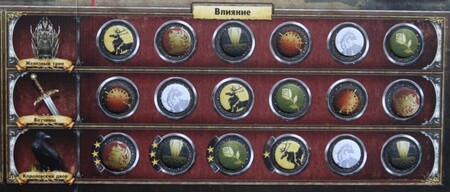
In Game of Thrones, formal authority is distributed across three tracks of influence—the Iron Throne, the Lordships, and the Royal Court. The House that occupies the first slot on each track receives the corresponding token of supremacy, which dictates the turn order, tie-breaking in battles, and the order of command distribution. These tokens are passed around, making authority temporary and cyclical rather than absolute. As Matting notes in a study of Diplomacy, formal levers of power in board games are most effective when perceived by participants as legitimate rather than imposed externally [2].
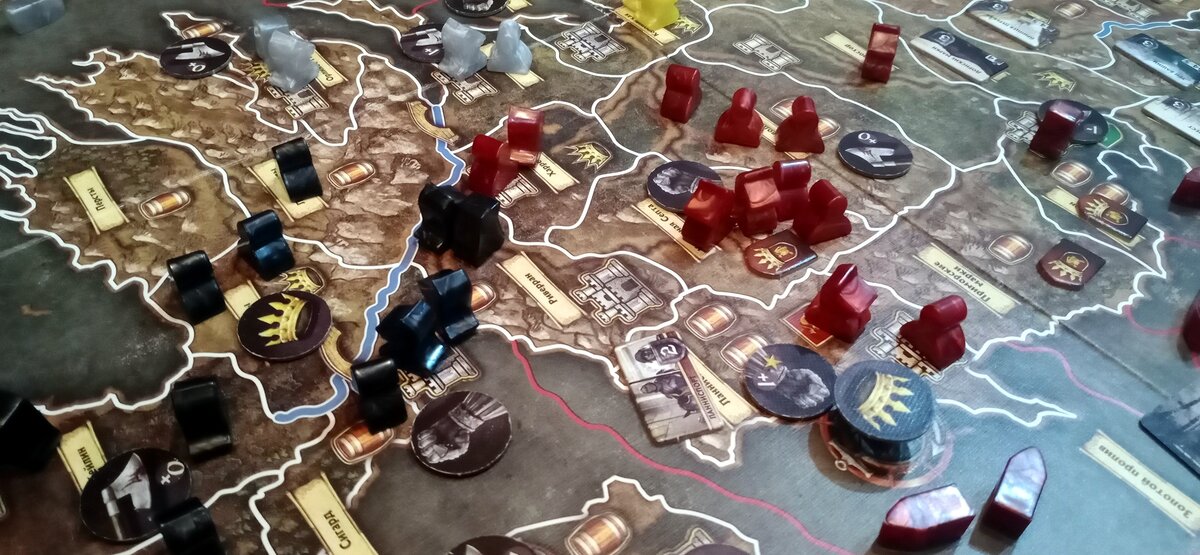
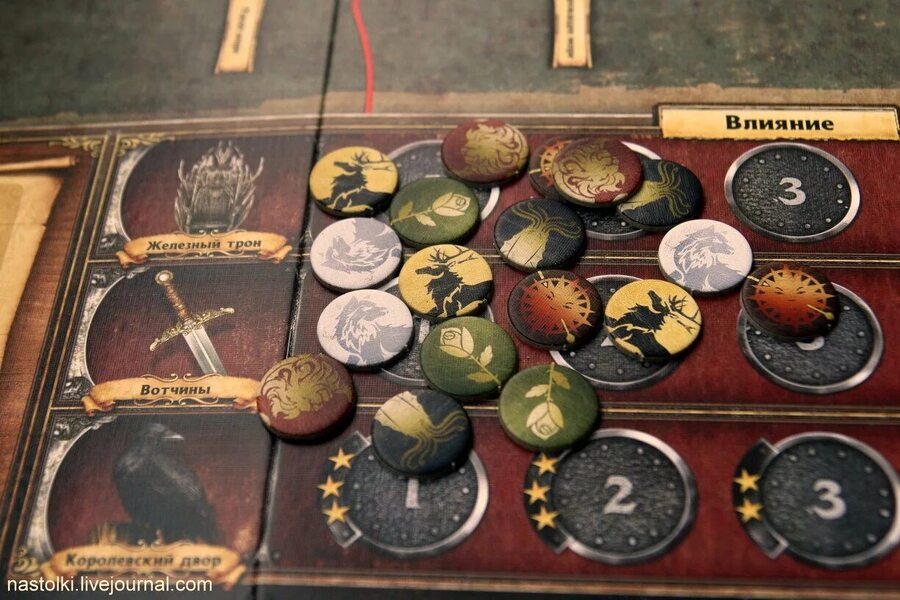
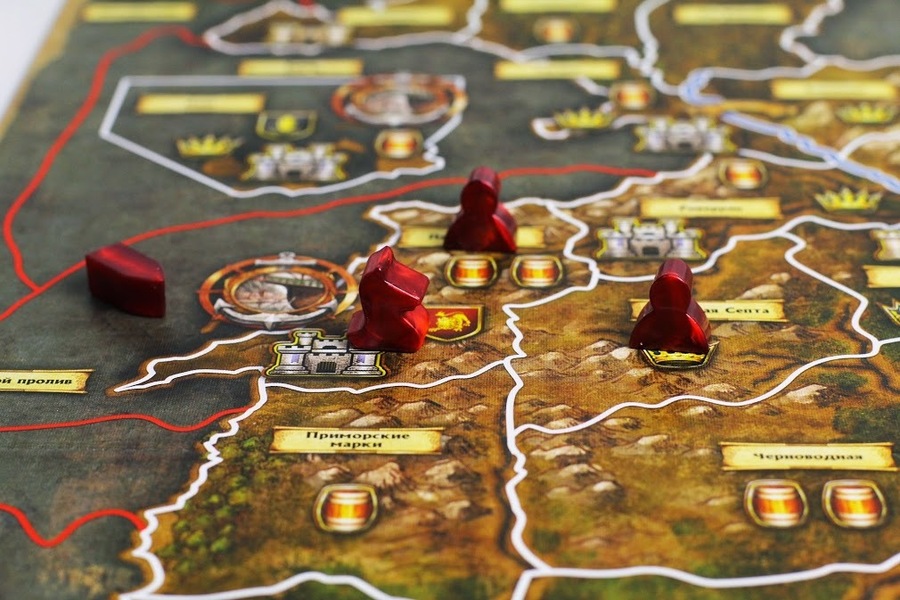
Formal authority in these games functions as a tool for ordering chaos. It provides players with predictable and legitimate levers of influence that structure interaction without suppressing it.
Asymmetrical authority of control
In Root, authority is realized through the asymmetry of factions—each possesses its own logic of power. The Marquise de Cat holds formal authority over control of the forest: she builds structures, places garrisons, and dominates the map. However, her power is imposed and systematically unpopular; the «Uprising» mechanic provokes other players to band together against her. In contrast, the Woodland Alliance gains strength through «support"—reputation among certain clearings. By winning the sympathy of the populace, the Woodland Alliance receives bonuses for the voluntary acknowledgment of its legitimacy.
As A. Herrero and collaborators point out, modern board games increasingly employ asymmetric mechanics to model various forms of social influence and team dynamics [1]. This contrast transforms authority into an independent game variable: the Marquis embodies power based on control and coercion, while the Forest Alliance demonstrates power based on reputation and consensus.
The game contrasts imposed versus earned authority, transforming them into conflicting gameplay styles and demonstrating that the legitimacy of power depends on its source.
Emergent authority and social memory
Authority in the Context of Hidden Objectives
In Dead of Winter and Nemesis, groups of players survive a catastrophe together, but each participant has a secret objective that may contradict the common goal (for example, «gather 3 food items, ” „kill a specific character, ” or „sabotage the colony“). In such conditions, any action—hiding resources, suspicious movement, or refusing to share medical supplies—sends a social signal about the player’s trustworthiness or selfishness. The formal rules do not directly track reputation, but it emerges organically through the interpretation of actions by the other participants.
As shown by S. Yang and colleagues in the COUP study, players form unstated metrics of trust and a «scale of hatred» that influence future decisions more profoundly than optimal strategy [3]. In Dead of Winter and Nemesis, this mechanism is amplified: one selfish action can instantly shatter a player’s standing as a reliable ally, and rebuilding that reputation requires several turns of consistent cooperative behavior.
In environments with hidden objectives, player authority is extremely fragile; it is built upon a social contract that can be easily broken by a single action, which transforms reputation into the game’s primary intangible asset.
Reputation as Social Capital
In Archipelago, players collaboratively develop islands, but the victor is the one who accumulates the most points. Choosing a role—Mayor, Builder, or Captain—grants a bonus to the leader; however, the action itself is performed by all players. This delegates authority and requires the leader to consider the group’s interests for overall efficiency. This mechanism transforms leadership from a privilege into a form of responsibility.
In the tabletop game Fallout, the «Idol» or «Despised» tokens do not provide direct mechanical bonuses, but they influence the encounter, companion, and quest cards the survivor faces. Thus, reputation becomes a narrative resource that shapes the gameplay experience through the lens of social perception.
As researchers note, social memory in board games creates unspoken metrics of trust that players carry from round to round, forming emergent patterns of cooperation and revenge[3].