
Concept
«Why It Became Popular» — a media outlet focused on modern trends, analyzing why some phenomena become mainstream while others do not. We investigate the root causes of popularity and illustrate the connections between culture, people, technology, business, and society.Goal To build a community around «Why It Became Popular» composed of young people interested in understanding contemporary culture through cause-and-effect relationships. The project should evolve into a media resource that people turn to not only to learn about a new trend but also to understand how and why it emerged, who shaped it, and what it reveals about the times we live in.
Data sources for media
The source material base for the media piece, «Why This Became Popular, ” includes academic research, analytical reports, statistics, journalistic materials, and digital platform data. Information is gathered from various fields—culture, psychology, sociology, economics, and technology.
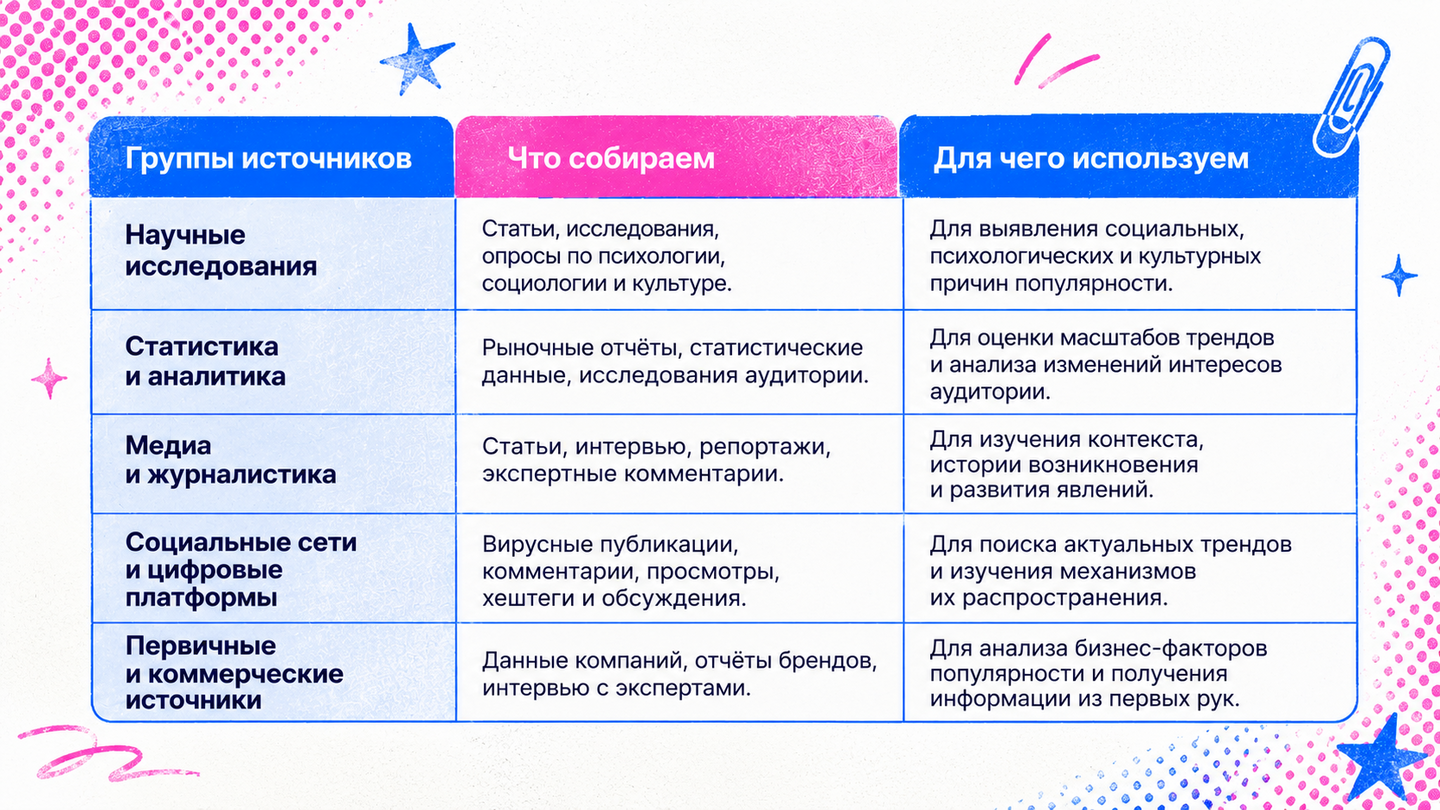
Where to Find Resources
Academic Databases: Google Scholar, ResearchGate, CyberLeninka, JSTOR. Analytical Platforms: Statista, DataReportal, Google Trends, Pew Research Center. Media: RBC, Forbes, The Guardian, The New York Times, Afisha Daily. Social Networks: TikTok, Instagram, YouTube, Telegram, Reddit, Pinterest. Industry Sources: official company websites, market research, and analytical agency reports.Principles for Working with Sources
When preparing materials, the editorial team prioritizes the credibility, relevance, and verifiability of information. Special attention is paid to comparing information across various disciplines—culture, psychology, economics, and sociology. Sources are used not only to describe a trend but also to uncover the reasons behind its emergence.Data Schema
The media piece, «Why It Became Popular, ” utilizes a mixed data processing model that combines automated tools with human expertise. Digital services and AI assist in collecting, systematizing, and analyzing information. The human element is responsible for verifying data accuracy, interpreting results, and editorial refinement.
The Core Principle: Technology assists in faster information retrieval and processing, but the final conclusions, fact-checking, and publication decisions always remain with the editorial team.
Guidelines for Automated Services in the Schema
1. Source Credibility and Research
Automated tools must utilize verifiable sources: research, official statistics, expert opinions, and authoritative media. It is essential to document citations to original sources and fact-check all information, strictly avoiding the use of unconfirmed data.
2. Trend Analysis and Drivers of Popularity
The system should not merely track relevant trends but also help identify the causes of their spread. This is achieved by analyzing search queries, social media, audience interests, and the dynamics of phenomenon popularity.
3. Interdisciplinarity
When researching any phenomenon, it is necessary to consider various factors: cultural, psychological, social, economic, and technological. This allows for the formation of a comprehensive explanation of popularity, rather than being limited to a single cause.
4. Tone of Voice and Style of Materials
AI must adhere to a media editorial style: clear, engaging, and investigative. Complex terminology, overly verbose phrasing, and excessive academic jargon should be avoided; instead, complex processes must be explained in accessible language.
5. Privacy and Copyright
When processing information, you must adhere to personal data protection rules, respect copyright, and cite sources for borrowed facts and materials. Internal editorial data must not be shared with third-party services without verifying the security terms.
6. Editorial Review and Quality
AI can assist in gathering information, structuring materials, and drafting content, but the final verification always remains the purview of the human. The editor is responsible for the factual accuracy, the logic of the conclusions, the quality of the writing, and the decision to publish. View and engagement statistics are utilized for the further development of the content.
Final Principle
The machine is responsible for collecting, processing, and analyzing information, identifying trends, and preparing materials. The human controls data accuracy, interprets results, edits content, and makes the final decisions on publication. Technology accelerates the work, but responsibility for quality and content always remains with the editorial team.