Concept
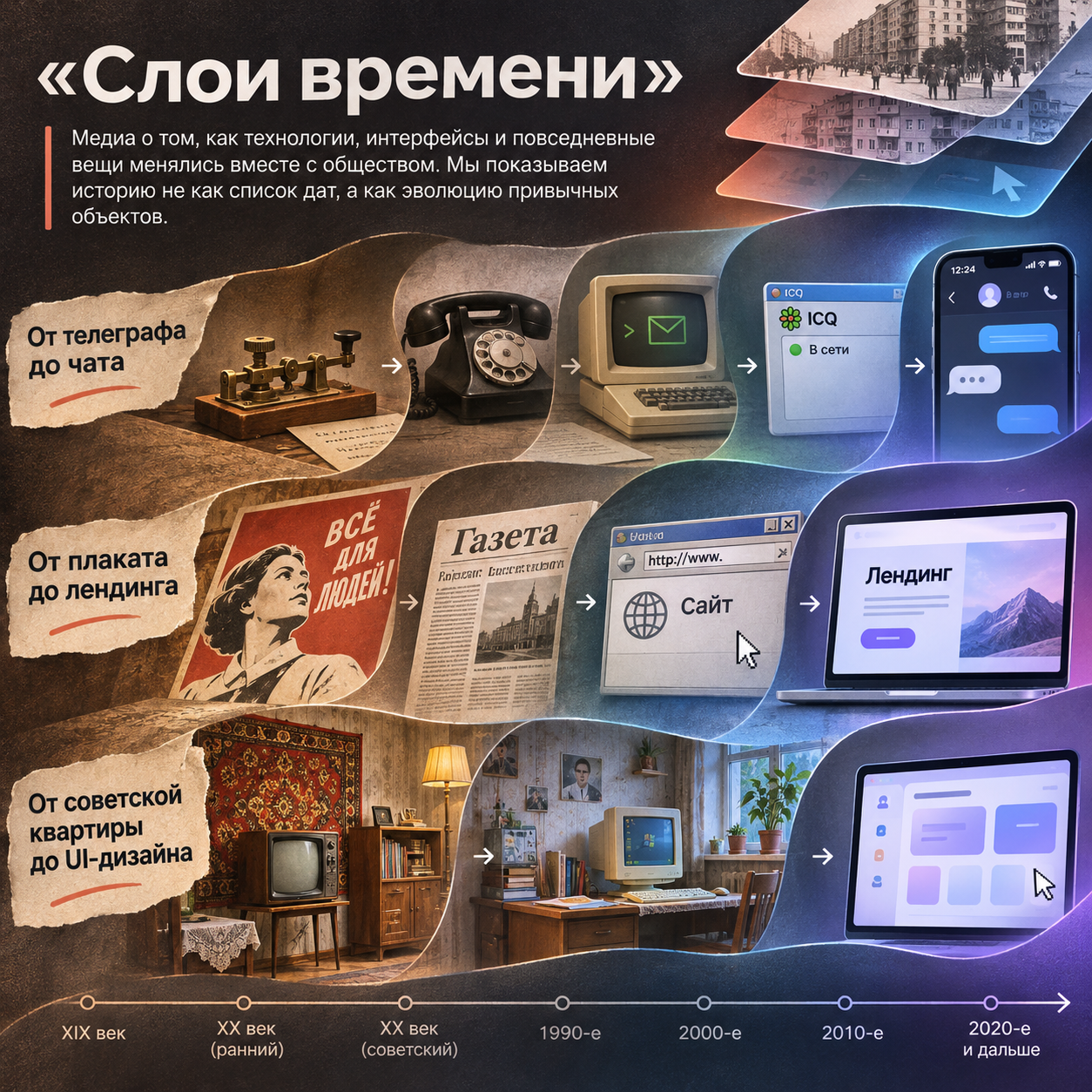
«Layers of Time» is a media project exploring how history manifests in objects, technology, interfaces, and everyday habits.
«Every interface is a fingerprint of its era.»
Media demonstrates that history is not just about dates and events; it encompasses buttons, typography, posters, subway maps, everyday objects, document formats, and screens. Through familiar objects, the project explains how society, technology, and human interaction with the world have evolved.
Data Sources for Media
Open Cultural and Archival Sources
Original Sources
- Proprietary Fact Base: events, dates, personalities, technologies, and artifacts.
- Image Library: scanned documents, photographs, posters, and diagrams, complete with source and licensing information.
- Idea Database: post topics, drafts, references, and visual discoveries.
- User Data: reactions, comments, polls, traffic, and reading completion rates.
- Expert Commentary: historians, designers, architects, developers, and museum staff.
Source Selection Principle
For every publication, the following are recorded: • original source or reliable secondary reference; • creation date of the material; • author or copyright holder; • image license; • reliability level: primary source, museum, encyclopedia, media outlet, user-generated content.
This protects the media from factual errors and issues with the use of visual materials.
Data Schema
The data is divided into two circuits: human—for editors, authors, and readers—and machine, for automatic search, classification, draft generation, and recommendations.
Data Sources │ ▼ Collection and Normalization │ ├── Human Curation │ • Editor fact-checks │ • Author selects the angle │ • Editor writes the copy │ • Designer prepares visuals │ • Lawyer verifies rights │ ├── Machine Processing │ • Entity extraction │ • Topic classification │ • Search for similar content │ • Draft generation │ • Timeline formation │ • Recommendations │ ▼ Unified Media Knowledge Base │ ▼ Publication and Feedback │ ▼ Analytics → Database refinement
Human Processing
Machine Processing
Guidelines for Automated Services
General Principles
- Automation assists, but it doesn’t replace the editor. The service can gather materials, identify connections, and prepare a draft, but the final decision remains with the human.
- Every fact must have a source. If the model cannot provide a source, the fact is flagged as unverified.
- Historical sensitivity is mandatory. Materials concerning war, repressions, national conflicts, and specific personalities cannot be published automatically without editorial review.
- Data provenance transparency. For every image, quote, and fact, the source, date, license, and link are retained.
- Consistent data structure. All materials must include mandatory fields: title, theme, era, geography, key subjects, sources, and verification status.
- Generation limitations. AI can suggest titles, outlines, theses, and drafts, but it cannot publish the final text without editorial refinement.
- Personal data protection. The service must not collect or publish users' personal data without justification and consent.
Guidelines for Generative Services