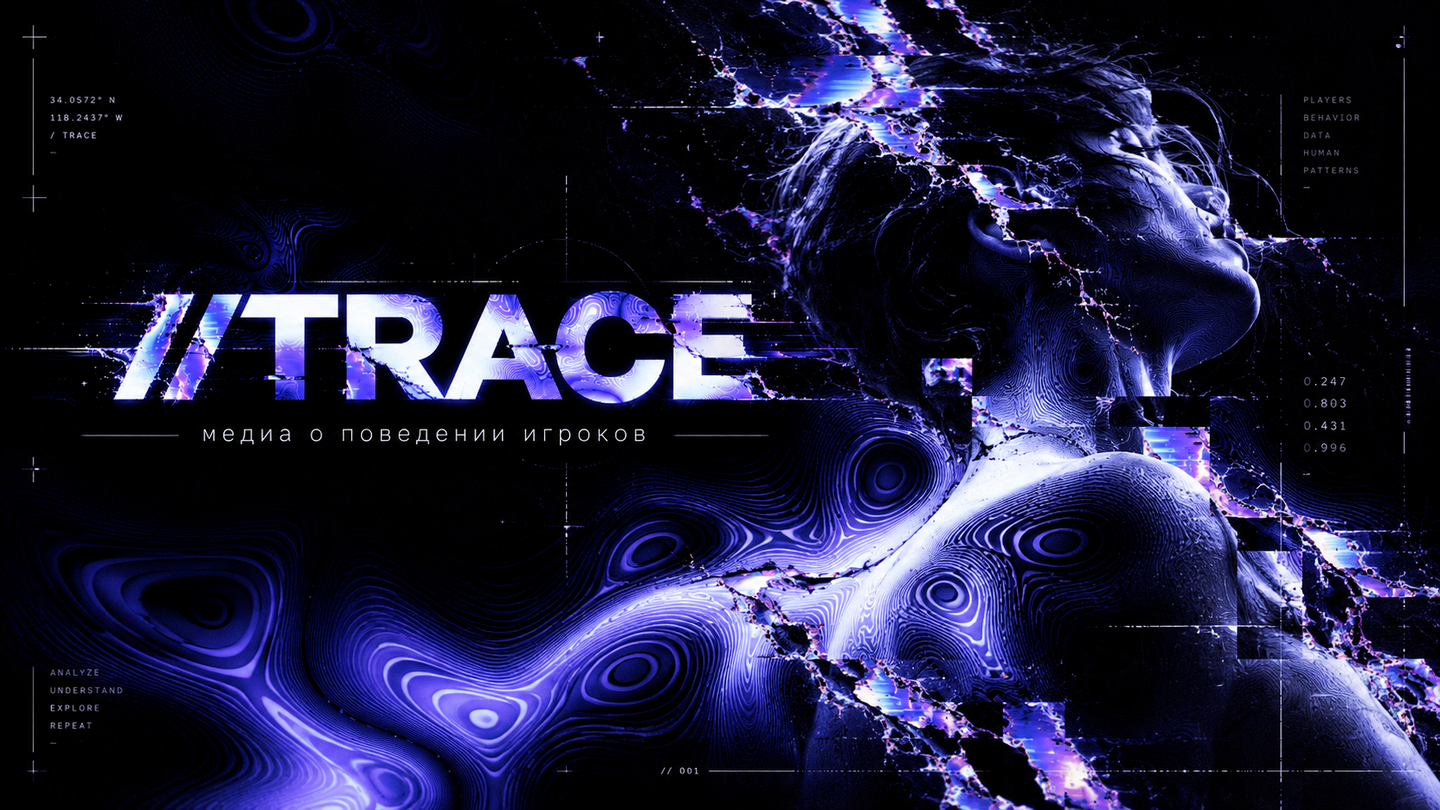
TRACE is a Russian-language media outlet exploring how game design influences human behavior.The project investigates why a player looks in a specific direction, chooses a particular path, notices a certain object, or makes a decision that appears entirely autonomous.
The primary object of study for TRACE is not the game’s plot, nor is it an assessment of its quality.
At the center is player behavior.
What he saw.
Where he went.
Where he stayed.
What he missed.
Why he did exactly that.
In one piece, the reader first sees a game scenario and makes their own decision. After that, they receive the results of other participants and a brief analysis of which design elements may have influenced the choice.
//Objective
Create accessible media about game design that allows users to learn gameplay mechanics not only through theory but also through their own interaction.
//Project Objective and Value
The Goals of TRACE To investigate human behavior within game environments. To explain gameplay mechanics using simple visual examples. To demonstrate the connection between a designer’s solution and a player’s reaction. To create a space where the reader becomes not just a spectator, but a participant in small playtests. Each of their actions can become part of the next piece of content.
Building an archive of game mechanics. Materials can be searched by mechanic, game type, problem, or method of player engagement. The same experiment is adapted for different platforms. Telegram is used for participation. VK is used for visual breakdowns. Long-form articles are used for a deeper study of the topic.
User Value To shift from the feeling: «I just went there» to the understanding: «I went there because the space was deliberately constructed that way.»
//Future Media Topics
TRACE sits at the intersection of several themes: game design, level design, player behavior, perception psychology, visual communication, and playtesting.
Media doesn’t attempt to cover all of game design. The core theme is always tied to one question: Why did the player do that?
Example:
In front of the player are two doors. The first is larger and directly in front of him. The second is smaller, but a light source is moving near it.
Which door will the person choose first?
First, the reader answers independently. Afterward, their choice becomes part of the overall statistics. Only then does TRACE explain the possible reasons for the result.
//01_Navigation
How a game guides a person in a direction without a direct arrow or text like «come here»
Direction Themes:
light; architecture; contrast; movement; color; orientation; spatial composition.Material Example: Why did 68 percent of players turn right? We show one room and two exits. After the vote, we only change the lighting and run the experiment again.
//02_Attention
What people notice first, and why
Themes of Study:
visual hierarchy; moving objects; color accents; silhouettes; sound; object placement on screen.Material Example: For a few seconds, the reader is shown a game scene. Afterward, they answer which object they noticed first. The results of all participants are overlaid onto the image.
//03_Selection
How Games Push People Toward a Specific Decision
Here, we examine: dialogue, awards, risk, option structure, visual presentation of choices, and prior gaming experience.
Example: The player is presented with two routes that yield the same reward. One is called Safe Path. The other is called Unknown Zone. Only the name changes. Does the audience selection change?
//04_Player_Errors