Embroidery is back at the heart of the fashion moment—but to understand why it isn’t fading, you need to know where it came from.
Marie Claire traces this history from the earliest embroidered fabrics to this season’s collections.
Emma Childs traces several key embroidery techniques—from their craft history to their revival on modern runways.
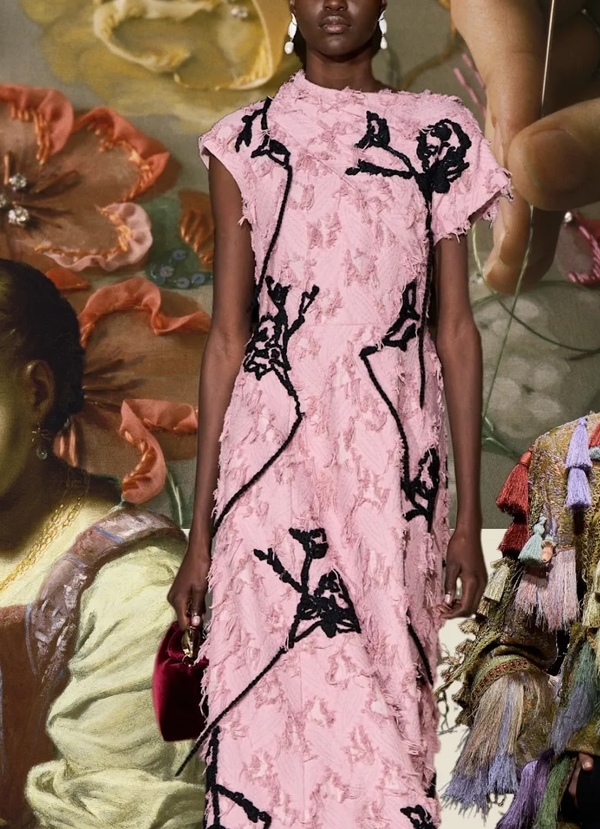
Crewelwork, which has roots in the Middle Ages and is known for the lush floral motifs of English aristocracy, was reinterpreted by Chloé in its Autumn 2025 collection. Broderie anglaise—a perforated embroidery with a lacelike effect—made a comeback through Michael Kors’ Spring 2025 line. Blackwork, inspired by Tudor England and brought over by Ekaterina Aragonskaya from Spain, is discernible in Dior’s Autumn 2025 collection.
Goldwork is examined separately—a technique that connects medieval England, ecclesiastical textiles, and today’s Burberry shows.
Beadwork and sequin embroidery are highlighted in a dedicated section: the author traces its journey from Egypt and Rome to the Parisian haute couture ateliers of the 20th century—Schiaparelli and Dior were the first to extensively use sequins and cut glass in their evening wear. A legendary example is the Saint Laurent jacket from 1988, embroidered by Lesage atelier based on Van Gogh’s sketches: over 600 hours of work, 250,000 sequins in 22 colors.
Today, beaded embroidery appears in every major show—and is actively cascading into the mass market.
The boom in artisanal embroidery in 2025, according to the article’s authors, is linked to several simultaneous factors: the revival of boho aesthetics, the demand for artisanship as a counterbalance to algorithmic trends, and a cultural interest in handmade work as a marker of time and identity.
Embroidery has stopped being merely a couture detail—it has become a form of expression.