Contents
- Concept
- Horizon
- Depth
- Diagonal
- Frame
- Conclusion
- Filmography and Sources
Concept
French film theorist André Bazin called the western the only genre whose «origins almost coincide with the origins of cinema itself.»
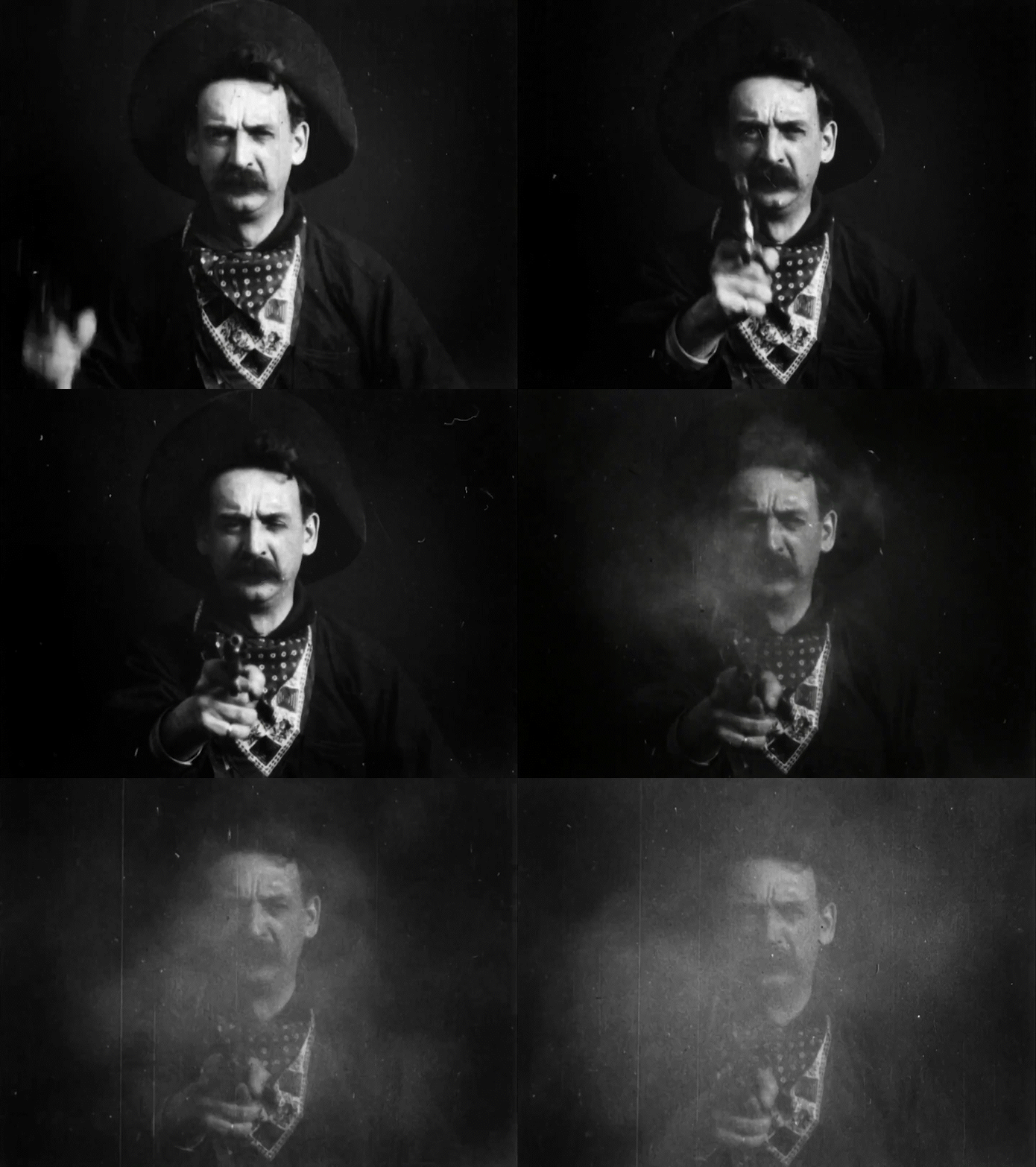
Still from the film «The Great Train Robbery,» directed by Edwin Porter, 1903.
Andre Bazin developed this idea, noting that the Western was an ideal genre for an art form like cinema because it provided room for visual storytelling, dynamic scenes, and heroic narratives. The Western genre truly grew alongside cinema; directors attempted to film things that cinema at the time was not yet capable of showing—namely, the open spaces beyond the studio sets. Since silent film lacked the support of dialogue, and intertitles paused the action, creators aimed to reflect everything possible using visual language on screen.
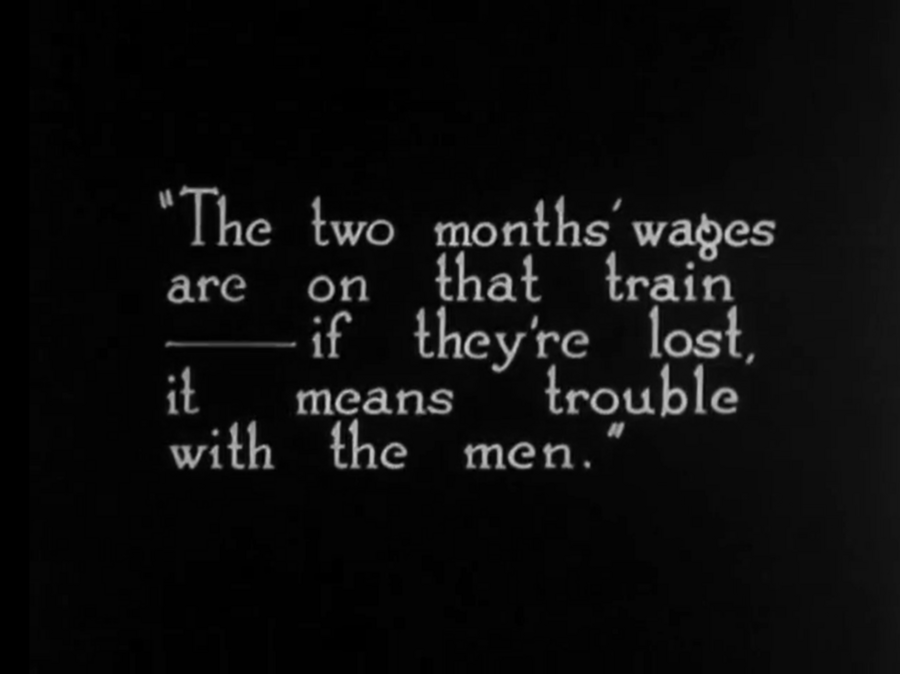
Intertitle from the film «The Iron Horse,» directed by John Ford, 1924.
In Westerns, the core conflict is not formed between people, but between man and the land—between civilization and wilderness. According to film scholar Kirill Goryachok, these opposing forces form the very foundation of the genre’s entire structure. In sound cinema, the conflict is often spoken aloud by the characters; in silent film, it had to be built visually within the frame.
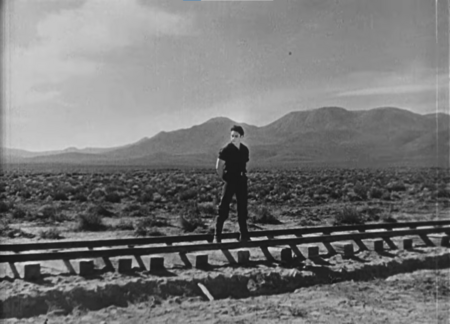
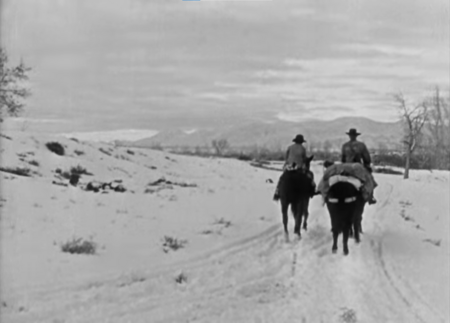
Stills from the film «The Iron Horse, ” directed by John Ford, 1924.
Such a conflict could only be staged by setting the camera in a real landscape. The journey from the pavilion to the desert took American cinema about a quarter of a century. The Great Train Robbery (1903) was shot at the Edison studio in New York and in a New Jersey forest park—the Wild West began there, just a few kilometers from the film studio. By the 1920s, Western filming had evolved into an expedition. Film historian Kevin Brownlow describes in detail how production crews organized the process during that era. The crew for The Covered Wagon (1923) lived in a tent camp in a valley in Utah. The filming unit for The Iron Horse (1924) spent the winter in rented circus train cars in the Nevada desert. For The Triumph of Barbara Wort (1926), a temporary town was constructed in the Black Rock desert for the 1,100-person film crew. During the filming of The Wind (1928) in the Mojave Desert, the heat was so intense that the film emulsion would melt, requiring the footage to be frozen. The complexity of these shoots is not simply historical detail—it is proof that genuine natural space became an asset as valuable to film companies as the movie stars themselves.
Stills from the film «Victory of Barbara Worth,» directed by Henry King, 1926.
Simply having a camera does not mean you have learned to capture space. Film scholar Scott Simmons notes that photographers solved the landscape problem back in the 1860s–1870s, but cinema took forty years to reach similar resolutions, appearing in later Westerns. Two technical limitations got in the way. First, the format: the silent film frame, with a nearly square aspect ratio of 1.33:1, could not encompass the breadth of the plains, forcing cinematographers to find new ways to handle space. Second, the film—orthochromatic emulsion of the 1910s—rendered the blue sky almost white and flat. The transition to panchromatic film brought back clouds and nuance to the sky. The Triumph of Barbara Wurt was entirely shot on this new panchromatic film. Thus, the Western gained a tool to make the landscape an integral part of the narrative.
Hypothesis
In the silent Hollywood Western, space assumes the role of narrator. The horizon line, the depth of the frame, the road’s diagonal, the window and door frames communicate to the viewer what will later be called words: the power of the land, the cost of the journey, the boundary between the «tamed» and the «wild.» The landscape ceases to be a mere backdrop and becomes an active character, and at times, an antagonist.
A still from the film «The Three Bad Men,» directed by John Ford, 1926.
Films for Study
I selected five Hollywood films for analysis: Edwin Porter’s The Great Train Robbery (Edison, 1903), James Cruze’s The Covered Wagon (Paramount, 1923), John Ford’s The Iron Horse (Fox, 1924), Ford’s The Three Bad Men (Fox, 1926), and Henry King’s The Triumph of Barbara Wort (Goldwyn, 1926).The films were chosen based on three criteria: 1) a significant portion was filmed on location, and the actual filming site is known; 2) the films are preserved in copies that are of good enough quality for frame analysis; 3) the film reflects the relationship between humanity and the land.
Movie posters selected for research
Method
Shots are analyzed based on four parameters: horizon line placement, direction of movement, figure-ground relationship, and light distribution. Each shot is addressed with the question: what does the viewer understand from the frame’s form without a title card?Acting, costume, and character archetypes are deliberately kept outside the scope of this study. The human figure is of interest here only as a measure of space: a point on the horizon or a silhouette within the composition. Film narratives are disclosed only to the extent necessary to understand the shot.
Horizon
The Horizon is the first challenge the Western confronts outside of the pavilion. It seems almost impossible to fit the scale of a natural landscape into a nearly square frame of silent film, yet the creators found ways to convey the vastness and construct a shot that needed no intertitle—it immediately conveyed the supremacy of the land’s scale compared to the human figure. In such a shot, the horizon also functioned as a boundary: whatever lay beyond it seemed to fade into the unknown.
A still from the film «The Great Train Robbery,» directed by Edwin Porter, 1903.
«The Great Train Robbery» is the film from which I am beginning my research, as it is one of the first attempts to move beyond the confines of the film studio to explore cinematography’s potential in the open world. Porter’s Western is partially shot in a New Jersey forest park, near the Edison studio—the horizon is not visible; it is obscured by trees, and the space remains enclosed, like a stage. The open horizon will appear later, when the camera reaches the real Wild West.
Still from the film «Covered Van,» dir. James Cruze, 1923.
In the frame from James Cruise’s film «The Transporter,» the ground dominates almost the entire shot, leaving only a thin, pale strip of sky at the top. The horizon here is not a line receding into the distance, but the crest of a hill, and people literally burst out from behind it—a technique that became iconic for the genre. Since one cannot hide on an open plain, such framing can evoke a sense of threat or cultivate a feeling of hope.
The horizon line functions like a stage: everything on it is visible from afar and becomes an event. Initially, tiny silhouettes appear against the sky, then a procession descends toward the viewer and grows larger before our eyes. In this way, a single composition conveys both distance and approach. The empty ground in the foreground reflects the journey that still lies ahead.
Another reason for the high horizon was the orthochromatic film, which rendered the blue sky nearly white and cloudless. Therefore, it was advantageous for the cinematographer to keep the sky narrow, allowing all the texture to remain anchored on the earth.
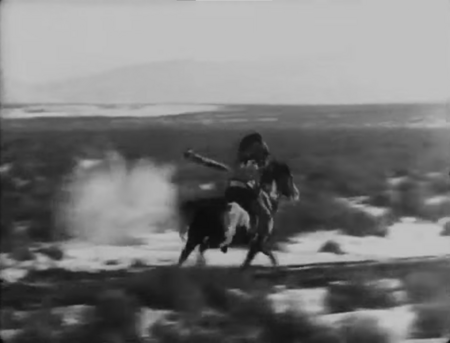
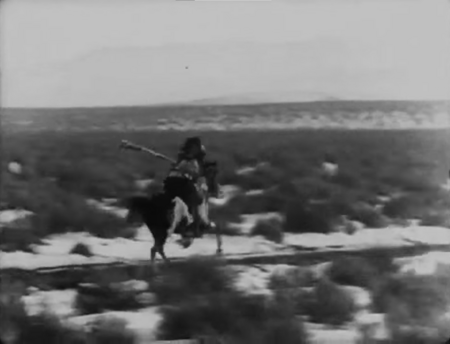
Stills from the film «The Iron Horse, ” directed by John Ford, 1924.
Here, the horizon is not a boundary, but a goal. The rider escapes the shots, and the viewer registers this: reaching the horizon means salvation. Yet, reaching it is practically impossible—the rider is galloping not toward the horizon, but parallel to it, so the horizon becomes the line guiding his run. The camera follows the hero and keeps him centered in the frame, meaning the objective of the movement remains ahead, just beyond the frame’s edge, never approaching.
Stills from the film «The Three Bad Men,» directed by John Ford, 1926.
In John Ford’s work, the horizon line divides the frame almost in half, yet there is hardly any sky visible; the upper half is filled with mountains, and only a narrow strip above the peaks remains light. The earth once again takes up nearly the entire frame, only this time it rises vertically. The caravan proceeds from a point just under the ridge toward the foreground, where the vans and riders become large. This is the same technique seen in James Cruze’s frame: a chain of figures emerges from the distance and grows toward the foreground, but in Ford’s work, the horizon does not reveal the unknown—it obscures it. The motionless mountains above the tiny vans render human movement transient: the caravan will pass, but the ridge will remain.